

Table of Contents
- What Is Compounded Semaglutide and How Does Monthly Cost Compare?
- Compounded Semaglutide Cost Per Month: Provider Pricing Breakdown
- Is Compounded Semaglutide Legal and Safe?
- Compounded Semaglutide Telehealth: How to Access and What to Expect
- Compounded Semaglutide Side Effects and Cost Implications
- Insurance Coverage, Hidden Fees, and Total Cost of Ownership
- Long-Term Maintenance Pricing and Cost Sustainability
- Comparing Top Providers: Features, Pricing, and Patient Support
Last Updated: July 26, 2026
What Is Compounded Semaglutide and How Does Monthly Cost Compare?
Compounded semaglutide is a GLP-1 agonist medication created by licensed pharmacies using FDA-approved ingredients, customized to individual patient needs. Unlike Ozempic or Wegovy, which are manufactured in standardized doses, compounded versions are prepared at 503A compounding pharmacies across the United States. Both contain the same active ingredient, but compounded versions skip clinical trial and marketing costs, passing savings to patients.
Compounded vs. FDA-Approved: Understanding the Cost Difference
Brand-name semaglutide typically costs hundreds of dollars monthly without insurance. Compounded semaglutide generally costs less due to lower manufacturing overhead. However, insurance coverage complicates this comparison. Many plans cover Ozempic or Wegovy for diabetes at $35-$50 copays, making brand-name options cheaper for insured patients. Compounded semaglutide’s advantage emerges for uninsured patients or those whose insurance won’t cover weight loss treatments.
Compounded semaglutide also offers flexibility that brand-name versions don’t: granular dose adjustments and multiple formulations (injectable, oral, sublingual) without switching manufacturers.
Compare total monthly cost of ownership, not just medication price. Some providers charge $99 for medication but add $79 membership fees. Others charge $149 flat-rate with no hidden fees. The lowest medication price isn’t always the lowest total cost.
Compounded Semaglutide Cost Per Month: Provider Pricing Breakdown
Pricing varies dramatically across providers. Mochi Health charges $79 monthly membership plus $99 medication ($178 total). Henry Meds operates on a flat $297 monthly model including provider evaluation and medication with no separate membership. IVIM Health mirrors Mochi at $74.99 membership plus $99 medication ($173.99 total). PlexusDx charges $149 monthly flat-rate regardless of dose strength, eliminating cost increases during titration.
| Provider | Monthly Medication Cost | Membership/Consultation Fee | Total Monthly Cost | Best For |
|---|---|---|---|---|
| Mochi Health | $99 | $79 | $178 | Comprehensive dietitian support |
| Henry Meds | $297 | Included | $297 | Simplicity and format variety |
| IVIM Health | $99 | $74.99 | $173.99 | App-based management tools |
| PlexusDx | $149 | None | $149 | Consistent pricing during titration |
Monthly Subscription Models and Dose-Based Pricing
Most providers operate on monthly subscriptions with automatic renewal. As patients titrate from starting doses (0.25mg weekly) to maintenance doses (1.0mg or higher), some pharmacies increase charges. Henry Meds and PlexusDx avoid this through flat-rate pricing, though at higher starting costs.
Before committing, read cancellation policies carefully. Some providers require 30 days’ notice and won’t refund unused doses.
Watch for auto-renewal traps. Some providers renew subscriptions automatically even if you’ve paused treatment. Verify cancellation policies in writing before your first charge posts.
Multi-Month Prepay Discounts and Long-Term Savings
Several providers offer discounts for longer commitments. The math depends on your confidence level. If you’re certain you’ll continue six months, prepaying saves money. If you’re uncertain about tolerance, month-to-month subscriptions provide flexibility despite higher per-month costs.
Is Compounded Semaglutide Legal and Safe?
Compounding is legal when performed by licensed 503A pharmacies operating under state pharmacy boards and FDA oversight. These facilities must meet quality standards, maintain proper equipment, and follow precise formulation protocols. A 503A pharmacy compounds medications for individual patients with prescriptions, while 503B facilities manufacture larger batches for distribution.
503A Pharmacy Standards and Quality Verification
Licensed 503A compounding pharmacies must comply with United States Pharmacopeia (USP) standards for sterile compounding. Verify pharmacy credentials through your state’s pharmacy board website. Reputable operations are happy to share their pharmacy license number, explain quality control processes, and provide documentation of USP compliance. Questionable operations deflect questions or claim such details are "confidential."
Safety Verification Checklist for Reputable Providers
Before starting compounded semaglutide, verify these safety markers:
- Provider names their compounding pharmacy explicitly
- Compounding pharmacy holds a current, active license from the state pharmacy board
- Provider confirms the pharmacy operates as a 503A facility
- Pharmacy maintains USP <797> certification for sterile compounding
- Provider offers consultation with a licensed physician or nurse practitioner before dispensing
- Medical history review includes screening for contraindications
- Provider supplies written information about potential side effects
- Medication arrives in sealed, sterile packaging with lot numbers and expiration dates
- Provider offers ongoing monitoring and dose adjustments
Compounded Semaglutide Telehealth: How to Access and What to Expect
Telehealth providers connect patients with licensed healthcare providers via video or phone. Patients complete online intake forms, receive prescriptions electronically, and have medication shipped home.
Getting a Prescription Online: Step-by-Step Process
Day one: complete online intake form and pay consultation fee ($0-$100). Within 24-48 hours, a provider schedules a consultation lasting 15-30 minutes, discussing medical history, weight loss expectations, and potential side effects. If disqualifying factors exist (medullary thyroid cancer history, family thyroid cancer history, pancreatitis history, or pregnancy), the provider declines to prescribe.
Upon approval, the provider issues an electronic prescription to the compounding pharmacy. Medication is filled in 1-3 business days and ships via overnight or 2-day carrier. Total timeline: typically 5-7 business days.
Start the process on a Monday or Tuesday. This timing ensures your consultation falls within the same week, pharmacy processing happens mid-week, and medication ships before the weekend.
Consultation Fees, Medical History Reviews, and Ongoing Oversight
Consultation fees vary. PlexusDx offers free provider evaluation. Mochi Health and IVIM Health bundle consultations into membership fees. Henry Meds includes consultation in flat-rate pricing.
Quality medical history review takes 10-15 minutes and screens for contraindications and metabolic health. Rushed reviews suggest volume optimization over patient safety. After starting medication, patients should have scheduled check-ins at weeks 1, 4, 8, and 12 to assess tolerance, side effects, and weight loss progress.
Compounded Semaglutide Side Effects and Cost Implications
The most common side effect is nausea, affecting 25-50% of patients in early weeks. Other frequent effects include constipation, fatigue, and vomiting in severe cases. Most patients develop tolerance within 1-2 weeks.
Nausea, Tolerance Issues, and Medication Adjustments
Nausea management often requires slower titration schedules (every two weeks instead of weekly) or anti-nausea medication (ondansetron or metoclopramide). These adjustments carry cost implications. Anti-nausea medications, if not covered by insurance, add $20-$50 monthly. Dietary modifications, eating smaller meals, avoiding fatty foods, staying hydrated, can reduce nausea without additional costs.
A small percentage of patients (5-10%) cannot tolerate semaglutide regardless of adjustments. This is why month-to-month subscriptions make financial sense. If tolerance proves impossible, you’ve only paid for one month rather than six.
Insurance Coverage, Hidden Fees, and Total Cost of Ownership
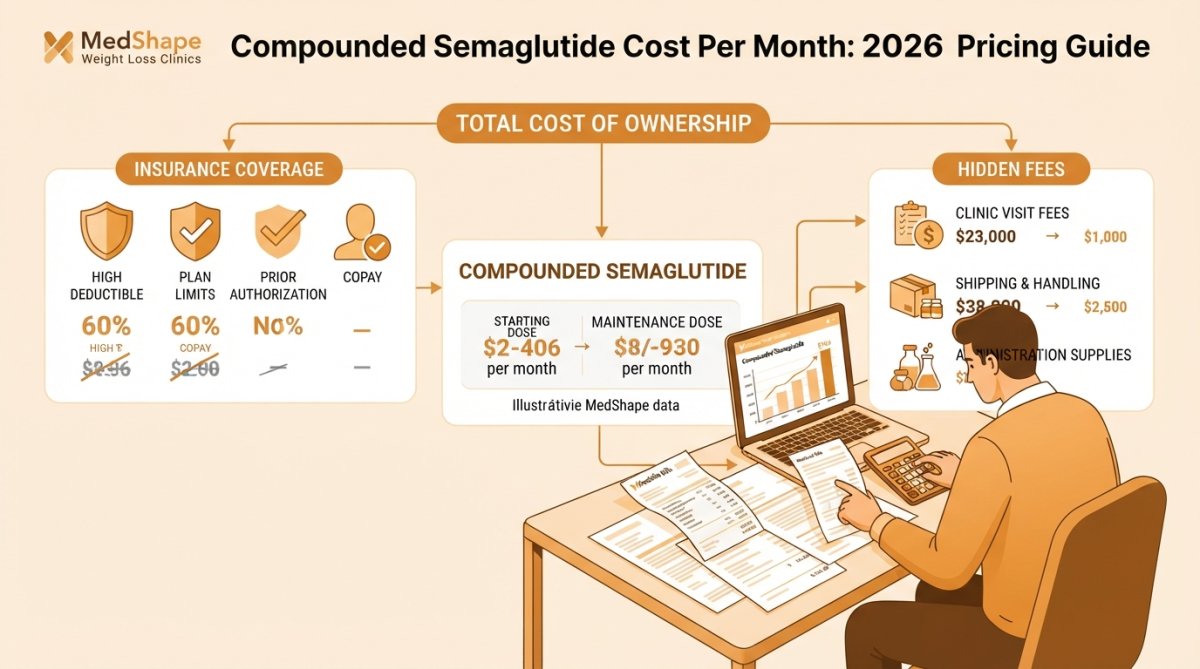
Insurance coverage for compounded semaglutide remains inconsistent. Some plans explicitly exclude compounded medications. Others cover them for FDA-approved indications (diabetes) but not off-label uses (weight loss). As of 2026, most weight loss programs using compounded semaglutide operate on a cash-pay basis.
Out-of-Pocket Costs Without Insurance Coverage
For uninsured patients, total monthly costs extend beyond medication:
- Medication: $99-$297 monthly
- Consultation/membership: $0-$79 monthly
- Shipping: typically included
- Follow-up appointments: $0-$50 per visit
- Anti-nausea medication: $0-$50 monthly if needed
- Bloodwork monitoring: $0-$200 every 3-6 months
Realistic total cost of ownership: $150-$400 monthly depending on provider and additional support needs.
Shipping Fees, Subscription Model Traps, and Transparent Pricing
Most providers include shipping, but verify explicitly. Transparent pricing means providers clearly state exact monthly costs, what’s included, cancellation policies, refund terms, whether costs increase with dose adjustments, and any required minimum commitments.
HSA/FSA Eligibility and Copay Assistance Programs
Compounded semaglutide typically qualifies as an eligible HSA/FSA expense, allowing patients to pay with pre-tax dollars and reduce costs by 20-30%. Verify with your plan administrator, as weight loss prescriptions in non-diabetic patients may not qualify. Some providers offer copay assistance programs or discount cards.
Long-Term Maintenance Pricing and Cost Sustainability
Weight loss with semaglutide typically follows a pattern: rapid loss in months 1-6, slower loss in months 6-12, and plateau thereafter. Most patients need to continue indefinitely to maintain weight loss. A patient paying $200 monthly faces $2,400 annually, $12,000 over five years, and $24,000 over a decade.
Dosage Titration Schedules and How Costs Evolve
Most providers follow a four-week titration protocol: 0.25mg weekly, increasing to 0.5mg, 0.75mg, and 1.0mg weekly. If pricing increases with dose strength, costs escalate during titration. Providers with flat-rate pricing eliminate this escalation. Some patients benefit from lower maintenance doses than their initial target, which may reduce monthly costs.
Prescription Renewal Frequency and Ongoing Provider Fees
Most patients need medication refills every 4-8 weeks. Some providers include unlimited renewals in subscription fees. Others charge $25-$50 per renewal. Over a year, the difference can be substantial. Similarly, some providers include unlimited follow-up consultations while others charge $50-$100 per consultation.
Comparing Top Providers: Features, Pricing, and Patient Support
Evaluating providers requires balancing price with reliable service and medical oversight. A cheap option delivering poor support isn’t cost-effective.
MedShape Weight Loss Clinics: Physician-Supervised Customization
MedShape Weight Loss Clinics distinguishes itself through board-certified physician oversight and customized treatment protocols. Rather than standardized dosing schedules, MedShape physicians adjust treatment based on individual metabolic response, side effect tolerance, and weight loss progress. The clinic’s signature Tirzepatide with B12 blend targets metabolic factors while providing nutritional support.
Telemedicine availability across all 50 states removes geographic barriers. Patients typically lose up to 20 pounds in four weeks, suggesting medically supervised dosing protocols. The cost structure isn’t publicly listed, requiring prospective patients to request quotes. This prevents direct price comparison but suggests personalized pricing based on individual treatment plans. MedShape’s 20+ year track record serving thousands of patients nationwide provides credibility.
Mochi Health: Transparent Membership Plus Medication Costs
Mochi Health’s strength lies in comprehensive support bundled with transparent pricing. The $79 monthly membership includes unlimited video visits with physicians or nurse practitioners, ongoing dietitian support, and app access for tracking progress and managing refills. The $99 medication cost sits mid-market. For patients valuing professional support beyond medication delivery, the combined $178 monthly cost includes resources other providers charge extra for or don’t offer.
Mochi’s insurance support helps patients navigate coverage for brand-name GLP-1s when available and assists with compounded medication costs for uninsured patients. The monthly membership without long-term commitment appeals to cautious patients.
Henry Meds: Flexible Subscription Options and Format Variety
Henry Meds offers multiple compounded semaglutide formats: injectable, oral tablets, and sublingual drops. This variety addresses patient preferences. The $297 monthly price is higher than competitors, but the flat-rate structure eliminates dose-based increases. A patient titrating from 0.25mg to 2.0mg pays the same $297 monthly regardless of dose strength.
Henry Meds’ free provider evaluation means patients only pay if medication is approved, reducing financial risk.
IVIM Health and PlexusDx: Flat-Rate and Membership Models
IVIM Health’s $74.99 membership plus $99 medication ($173.99 total) positions it as a lower-cost alternative to Mochi while including membership benefits. App-based management tools appeal to tech-savvy patients.
PlexusDx’s $149 flat-rate model appeals to patients prioritizing simplicity. No membership, no dose-based increases, no hidden fees. For patients wanting straightforward medication delivery without comprehensive support services, PlexusDx delivers exactly that.
| Provider | Total Monthly Cost | Best For | Unique Feature |
|---|---|---|---|
| MedShape Weight Loss Clinics | Customized (call for quote) | Comprehensive customization and physician oversight | Board-certified physicians, Tirzepatide option |
| Mochi Health | $178 | Comprehensive support with dietitian access | Unlimited professional consultations included |
| Henry Meds | $297 | Format flexibility (injectable, oral, sublingual) | Multiple medication formats available |
| IVIM Health | $173.99 | Tech-forward patients preferring app-based management | Digital health tools and app access |
| PlexusDx | $149 | Budget-conscious patients wanting simplicity | Flat pricing regardless of dose strength |
The “best” provider depends on your priorities. If customization and medical oversight matter most, MedShape Weight Loss Clinics delivers that. If comprehensive support appeals to you, Mochi Health justifies its higher cost. If simplicity and budget are primary concerns, PlexusDx offers the lowest transparent pricing.
Choosing a compounded semaglutide provider requires balancing cost against quality, support, and long-term sustainability. The lowest-priced option isn’t always most cost-effective when factoring in hidden fees, limited oversight, and potential treatment failures. MedShape Weight Loss Clinics provides physician-supervised customization that helps patients achieve meaningful weight loss while managing side effects effectively. With board-certified physicians, telemedicine availability across all 50 states, and a proven track record helping patients lose significant weight safely, MedShape offers the comprehensive approach that transforms weight loss from a temporary diet into a sustainable health transformation. Contact MedShape Weight Loss Clinics today to discuss your treatment options and receive a personalized pricing quote based on your specific needs.
Frequently Asked Questions
How much does compounded semaglutide cost per month without insurance?
Compounded semaglutide cost per month varies significantly by provider and subscription model. Based on current market offerings, month-to-month subscriptions typically range from approximately $99 to $297, depending on dose strength and provider overhead. Longer prepaid plans (6-12 months) often offer discounts. MedShape Weight Loss Clinics offers customized pricing based on your specific treatment plan, visit their website for a personalized quote. Always ask providers about all-inclusive pricing versus separate medication and consultation fees.
Is compounded semaglutide cheaper than brand-name Ozempic or Wegovy?
Compounded semaglutide is generally more affordable than FDA-approved options when purchased out-of-pocket, as it avoids manufacturer markups and brand-name pricing. However, if you have insurance coverage for Ozempic or Wegovy, your copay may be lower than compounded alternatives. Compounded versions are not FDA-approved, which affects pricing and insurance reimbursement. For cost-effective alternatives to name-brand medications, compare both the medication cost and consultation fees across providers, as total monthly expenses vary significantly.
What factors influence compounded semaglutide cost per month?
Several factors affect monthly costs: dose strength (higher doses cost more, though some providers offer flat-rate pricing), subscription duration (prepay discounts available), pharmacy overhead (503A compounding facilities vary), consultation and provider fees, shipping costs, and whether the provider bundles membership or dietitian support. Some providers charge separate fees for medical history review and ongoing clinical oversight. Transparency about all fees upfront is crucial, ask providers for a complete cost breakdown before committing to treatment.
Are there hidden fees with compounded semaglutide subscriptions?
Yes, common hidden costs include consultation fees ($50-$150), shipping fees ($10-$25 per month), membership or platform fees (ranging from $75-$99 monthly), prescription renewal fees, and medical history review charges. Some providers advertise low medication costs but bundle separate membership requirements. To avoid surprises, request a detailed cost breakdown covering medication, all provider fees, shipping, and any recurring subscription charges. Transparent providers like PlexusDx offer flat-rate pricing that doesn't increase with dose adjustments, helping you predict total monthly expenses.
Is compounded semaglutide safe despite not being FDA-approved?
Compounded semaglutide is prepared by licensed 503A compounding pharmacies under strict pharmaceutical standards, but it lacks FDA approval for weight loss. Safety depends heavily on pharmacy quality, provider clinical oversight, and proper dosage titration. To verify safety, confirm your provider uses licensed 503A facilities, requires medical history review, monitors for side effects, and offers dose adjustments if nausea or tolerance issues occur. Reputable telehealth providers include ongoing physician or nurse practitioner supervision. If you've experienced side effects with brand-name GLP-1s, discuss tolerance concerns with your provider before starting compounded versions.
This article was written using GrandRanker






























Leave A Comment