
Table of Contents
- What Is Compounded Semaglutide and How Does It Differ From Brand-Name Versions?
- FDA Approval Status and Safety Considerations in 2026
- How to Get Compounded Semaglutide Online Safely: Step-by-Step
- Best Online Semaglutide Providers: Comparison and Vetting
- Cost Breakdown: Membership Fees vs. Medication Costs
- Shipping, Delivery Timelines, and Prescription Management
- Common Side Effects and How Compounded Formulations Address Tolerability
- Getting Compounded Semaglutide Online: What to Avoid
Get Compounded Semaglutide Online 2026: Safe Providers & Costs
Last Updated: July 25, 2026
When looking to get compounded semaglutide online 2026, understanding how to navigate telehealth providers safely is essential. The compounded semaglutide market has evolved significantly since the nationwide shortage ended, offering more options but also more risk. At MedShape Weight Loss Clinics, we’ve tracked how patients successfully access these medications while avoiding counterfeit products and unlicensed prescribers. Below, we’ll show you exactly how to verify providers, understand the regulatory environment, and compare your best options for getting compounded semaglutide online safely in 2026.
The key difference between a legitimate compounded semaglutide provider and a risky one comes down to three things: pharmacy accreditation (PCAB certification), licensed physician oversight, and transparent pricing. Verify all three before placing an order.
What Is Compounded Semaglutide and How Does It Differ From Brand-Name Versions?
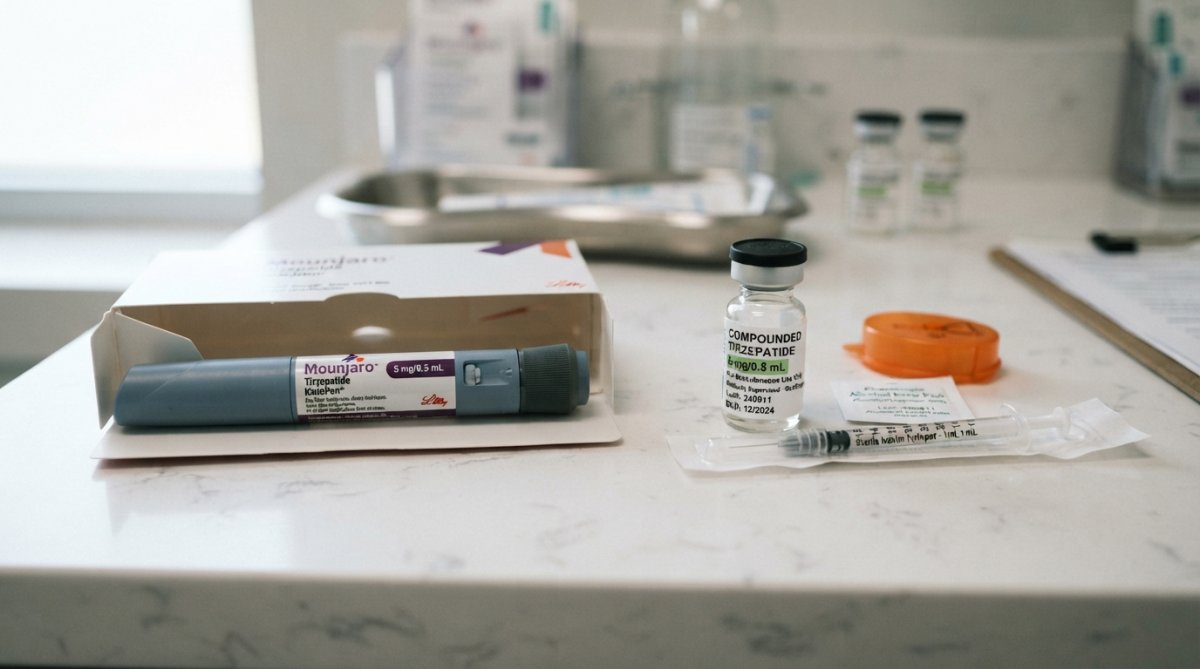
Compounded semaglutide is a custom-made version of the GLP-1 receptor agonist manufactured by licensed compounding pharmacies rather than pharmaceutical companies. Unlike Ozempic and Wegovy, which are mass-produced with FDA-approved formulations, compounded versions are prepared specifically for individual patients based on a physician’s prescription.
The core active ingredient is identical in both. Brand-name medications undergo rigorous FDA approval with standardized manufacturing and quality control. Compounded versions are created in state-licensed compounding pharmacies following USP (United States Pharmacopeia) standards but operate under a different regulatory framework. Compounded semaglutide typically costs 40-60% less per dose than Ozempic or Wegovy because it bypasses pharmaceutical company markups. However, this comes with trade-offs: less clinical data on long-term outcomes, potential variation in formulation consistency, and reliance on pharmacy quality controls. The injectable form remains the standard; oral or sublingual versions lack clinical evidence and should be avoided.
FDA Approval Status and Safety Considerations in 2026
The FDA does not "approve" compounded medications traditionally. Instead, compounding pharmacies operate under Section 503A of the Federal Food, Drug, and Cosmetic Act, which allows licensed pharmacists to compound medications when prescribed by a licensed physician.
Post-Shortage Regulatory Landscape
The semaglutide shortage of 2023-2024 created a window where unlicensed operations proliferated. The FDA issued multiple warning letters to compounders producing non-sterile, mislabeled, or contaminated semaglutide. By 2026, regulatory enforcement has tightened significantly with regular facility inspections and clearer guidelines. A critical 2026 development is the FDA’s renewed focus on pharmacy accreditation verification. Pharmacy Compounding Accreditation Board (PCAB) certification is now the industry standard separating legitimate operations from questionable ones. Verify PCAB accreditation before placing orders.
Insurance reimbursement for compounded semaglutide remains limited in 2026. Most major insurers classify it as non-covered because it lacks FDA approval status. However, some regional health plans and Medicare Advantage plans have begun covering it when prescribed for specific indications. Contact your insurance provider directly to confirm coverage.
The FDA has identified counterfeit semaglutide sold through unverified online channels. These fake products often contain little to no active ingredient or harmful contaminants. If a provider cannot produce proof of PCAB accreditation and licensed physician involvement, do not purchase from them.
How to Get Compounded Semaglutide Online Safely: Step-by-Step
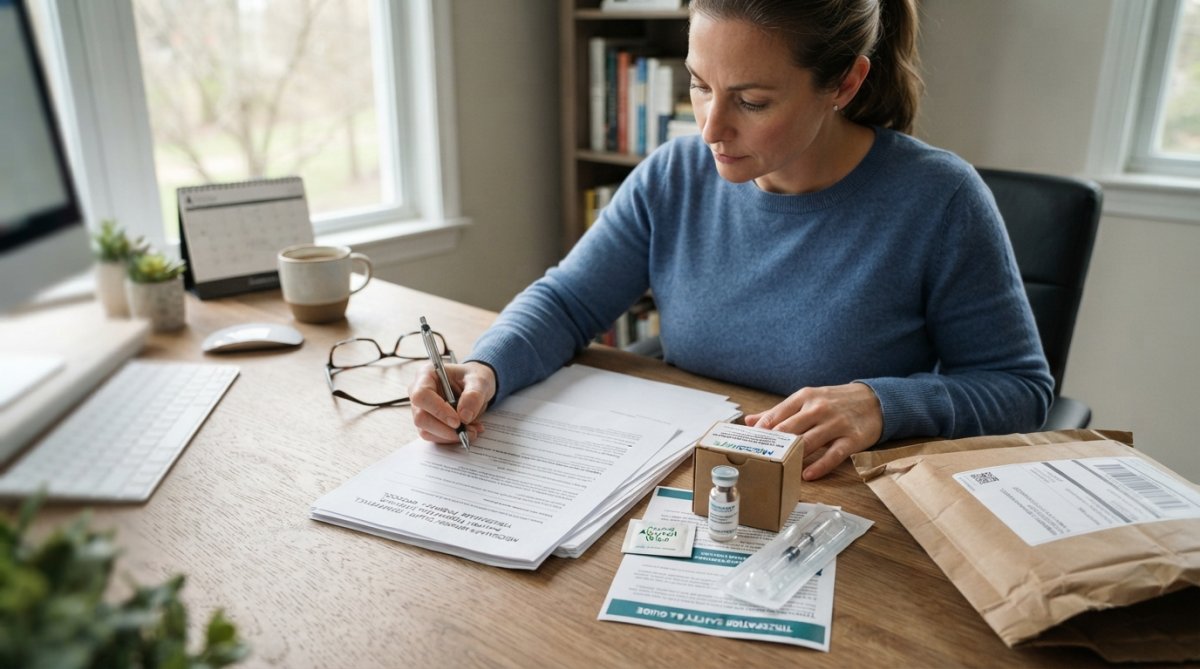
Getting compounded semaglutide online requires following a specific sequence to ensure safety and legitimacy. This process typically takes 7-14 days from initial consultation to receiving your first dose.

Step 1: Research and Verify the Provider (2-3 hours)
Identify 3-5 telehealth providers offering compounded semaglutide. Look for established websites, clear contact information, and transparency about pharmacy partners. Search for "[Provider Name] PCAB accreditation" and cross-reference the pharmacy name with the PCAB directory at Pharmacy Compounding Accreditation Board directory. If the pharmacy doesn’t appear in the PCAB registry, move on.
Step 2: Schedule Your Initial Consultation (same day to 48 hours)
Book a virtual consultation with a licensed physician. This 15-30 minute appointment covers your medical history, current medications, weight loss goals, and contraindications. Be prepared to discuss previous weight loss attempts, metabolic conditions, and any history of pancreatitis or thyroid cancer (absolute contraindications for GLP-1 agonists).
Step 3: Complete Lab Work (3-5 days)
After consultation, the physician orders baseline lab work: fasting glucose, liver function tests, kidney function tests, and thyroid panel. Complete these at a local facility (Quest Diagnostics, LabCorp) or through an at-home kit if offered. Results are usually available within 48 hours.
Step 4: Receive Your Prescription and Place Order (1-2 days)
Once labs are reviewed and you’re cleared, the physician sends your prescription to the compounding pharmacy. You’ll receive a confirmation email with pricing, shipping information, and injection instructions. Payment is typically due at this stage.
Step 5: Receive Your Medication (3-5 business days shipping)
Your compounded semaglutide ships via overnight or 2-day delivery with cold packs. Upon arrival, store it in the refrigerator at 36-46°F. Do not use if the package shows damage or if the medication appears discolored.
Verify Pharmacy Accreditation and Licensed Physician Requirements
Pharmacy accreditation is non-negotiable. PCAB sets rigorous standards for sterility, quality control, and ingredient sourcing. Accredited pharmacies undergo regular third-party inspections. When ordering, the provider should send you the pharmacy’s PCAB certificate upon request. Licensed physicians must be licensed in your state and board-certified in a relevant specialty (internal medicine, family medicine, obesity medicine). Verify credentials through your state’s medical board or FSMB (Federation of State Medical Boards) physician lookup.
Red flags include providers who skip physician consultation, offer prescriptions without lab work, or refuse to disclose their pharmacy partner’s name. Legitimate operations are transparent about every step.
Medical Consultation and Lab Work Process
The medical consultation screens for contraindications and establishes a baseline for monitoring. Lab work ensures you’re safe to start the medication and provides a baseline for tracking metabolic changes. Fasting glucose reveals undiagnosed diabetes. Liver and kidney function tests confirm your organs can safely process the medication. Thyroid panel screens for pre-existing thyroid disease, which can be exacerbated by GLP-1 agonists. Some providers offer at-home lab collection kits, eliminating facility visits.
Dosage Titration and Monitoring
Compounded semaglutide follows the same titration schedule as brand-name versions. Most providers start at 0.25 mg weekly for four weeks, then increase to 0.5 mg weekly for weeks 5-8. Doses escalate to 1 mg, then 1.5 mg, and potentially up to 2.4 mg weekly, depending on tolerance and response. Gradual titration allows your body to adjust and minimizes gastrointestinal side effects.
Monitoring typically includes check-ins at weeks 4, 8, 12, and 16 to assess tolerance, weight loss progress, and adverse effects. This oversight ensures safe response and allows dose adjustments if needed.
Best Online Semaglutide Providers: Comparison and Vetting
When evaluating telehealth providers for compounded semaglutide, focus on verifiable credentials and transparent operations rather than marketing claims.
| Provider Attribute | What to Look For | Red Flag |
|---|---|---|
| Pharmacy Accreditation | PCAB certification visible on website or provided upon request | Refuses to name pharmacy or claims "proprietary" formulation |
| Physician Credentials | Board-certified in internal medicine, family medicine, or obesity medicine | No physician involved; prescriptions issued by NP/PA without physician oversight |
| Lab Work Requirement | Mandatory baseline labs before prescription | Offers prescription without any lab work |
| Pricing Transparency | Clear pricing per dose, membership fees listed upfront | Hidden fees; pricing only revealed after consultation |
| Shipping & Storage | Overnight or 2-day delivery with cold packs; clear storage instructions | Standard mail; no temperature control during transit |
| Monitoring Schedule | Regular check-ins (monthly minimum) with dose adjustments | One-time prescription with no follow-up |
| Money-Back Guarantee | 30-day satisfaction guarantee or similar | No refund policy; non-refundable upfront payments |
Key Features to Compare Across Providers
Membership vs. No-Membership Models
Some providers operate on a membership model charging $99-199 monthly, which includes telehealth consultations, lab work, and monitoring, with additional charges for medication. Others charge no membership fee but higher per-dose medication costs. A no-membership provider might charge $150 per dose with a $50 consultation fee and $100 for labs, totaling roughly $2,500-3,500 annually. A membership model might charge $150/month ($1,800/year) plus $100 per dose, totaling $3,000-4,200 annually.
Telehealth Availability and Response Times
Legitimate providers offer telehealth consultations during business hours, typically 8 AM to 6 PM in multiple time zones. Check for weekend appointments and response times. A 24-hour response time is standard.
Dosage Flexibility and Customization
Some providers offer only pre-set dosage schedules. Others allow physicians to customize titration based on your tolerance and response. If you’ve had previous GLP-1 agonist experience and tolerate higher doses well, seek a provider allowing faster titration.
Busy professionals and shift workers should prioritize providers offering evening and weekend appointments. Patients with previous GLP-1 tolerance should choose providers allowing customized dosage titration.
Cost Breakdown: Membership Fees vs. Medication Costs
When getting compounded semaglutide online 2026, your total cost includes several components.
Consultation Fees: Initial consultations range from $50-150. Follow-up consultations may be free under a membership model or cost $30-75 on a pay-per-visit plan.
Lab Work: Baseline labs cost $100-200 and are usually required once. Follow-up labs (every 3-6 months) cost $50-150.
Medication Costs: Compounded semaglutide typically costs $100-200 per dose. At standard dosing, you’ll need 4 doses per month, totaling $400-800 monthly. This shows the cost advantage over brand-name Ozempic or Wegovy at $900-1,300 per month without insurance.
Membership Fees: Providers using membership models charge $99-299 monthly, usually including unlimited consultations and monitoring but not medication.
Total Annual Cost Estimate: Expect $4,800-9,600 annually depending on your provider model and dosage.
Insurance Reimbursement Pathways and Coverage Options
Insurance coverage for compounded semaglutide remains limited in 2026. Most major insurers classify it as non-covered because it’s not FDA-approved traditionally. However, several pathways exist.
Prior Authorization: Contact your insurer and ask whether your plan covers "compounded medications" for weight loss. Some regional plans do, especially if you have weight-related comorbidities. Request a prior authorization form for your physician to complete.
Medicare Advantage Plans: Certain Medicare Advantage plans (Part C) have begun covering compounded semaglutide. Call your plan directly to confirm. Traditional Medicare does not cover it.
Health Savings Accounts (HSA) and Flexible Spending Accounts (FSA): Both can be used to pay for compounded semaglutide if prescribed by a licensed physician, allowing you to use pre-tax dollars and save 20-35% in taxes.
State Medicaid Programs: A handful of state Medicaid programs have added compounded semaglutide to their formularies for beneficiaries with obesity and comorbidities. Contact your state Medicaid office to confirm eligibility.
According to American Medical Association guidance on compounded medications, having your physician document medical necessity thoroughly strengthens insurance appeals.
Shipping, Delivery Timelines, and Prescription Management
Compounded semaglutide must be kept between 36-46°F (2-8°C) throughout transit. Legitimate providers ship via overnight or 2-day delivery with insulated packaging and ice packs to maintain temperature control. Orders placed by Wednesday usually arrive by Friday or Monday. Tracking information is provided via email. Most providers use FedEx or UPS with signature required.
Storage After Arrival: Store immediately in the refrigerator. Do not leave at room temperature for more than 30 minutes. Each pen or vial includes an expiration date (typically 30 days from compounding).
Prescription Refills: Most providers allow refills through a patient portal or customer service. Refills typically process within 24 hours and ship within 2-3 business days. Some offer auto-refill options where new doses ship automatically each month.
Common Side Effects and How Compounded Formulations Address Tolerability
Semaglutide’s most common side effects are gastrointestinal: nausea, vomiting, constipation, and diarrhea, occurring in 30-50% of users, particularly during the first 4-8 weeks. Slow titration helps minimize these effects.
Nausea Management: Eat smaller, frequent meals (5-6 per day instead of 3). Avoid fatty or greasy foods. Some patients find ginger supplements, vitamin B6, or acupressure wristbands helpful.
Vomiting and Appetite Loss: These typically resolve within 2-4 weeks. If vomiting persists beyond week 6, contact your provider; you may need slower titration or dose adjustment.
Constipation: Increase water intake to 3+ liters daily, add fiber supplements (psyllium husk), and consider a stool softener like docusate sodium. Regular exercise helps significantly.
Injection Site Reactions: Some patients report redness, swelling, or itching at injection sites. Rotating sites (abdomen, thigh, upper arm) reduces this risk. Most reactions resolve within 24 hours.
Compounded formulations don’t inherently reduce side effects compared to brand-name versions; the active ingredient is identical.
If nausea is severe, ask your provider about adding a low-dose anti-nausea medication like ondansetron (Zofran) temporarily. This common off-label practice helps patients through the initial adjustment period.
Getting Compounded Semaglutide Online: What to Avoid
Several practices and red flags should disqualify a provider from consideration.
Avoid Providers Without Physician Involvement: Some platforms offer "prescriptions" issued by nurse practitioners or physician assistants without physician oversight. Weight loss medications require physician-level judgment.
Avoid Unverifiable Pharmacy Claims: If a provider refuses to name its compounding pharmacy or claims it’s "proprietary," walk away. Legitimate operations are transparent about pharmacy partners.
Avoid Unusually Low Pricing: Compounded semaglutide costing significantly less than $100 per dose (like $50 or $75) raises questions about ingredient sourcing or formulation accuracy.
Avoid Providers Skipping Lab Work: Any provider offering semaglutide without baseline lab work is cutting corners dangerously.
Avoid Social Media-Only Operations: Providers operating exclusively through Instagram, TikTok, or Facebook without a professional website or phone number are high-risk.
Avoid Pressure to Buy Large Quantities Upfront: Some providers push patients to buy 3-6 months of medication upfront at a discount. This locks you into their service and makes switching harder.
Avoid Providers with No Refund Policy: Reputable providers offer a 30-day money-back guarantee.
According to FDA guidance on buying medications online safely, verify that any provider is registered with your state’s pharmacy board.
Choosing where to get compounded semaglutide online 2026 requires due diligence, but the payoff is significant cost savings and safe, medically supervised weight loss. MedShape Weight Loss Clinics specializes in compounded Tirzepatide and Semaglutide treatments with board-certified physicians, PCAB-accredited compounding partners, and customized dosage plans. By verifying pharmacy accreditation, confirming physician credentials, and understanding your total costs upfront, you can confidently access compounded semaglutide while avoiding counterfeit products and unlicensed operators. Start with a consultation to establish your baseline, follow the titration schedule carefully, and work with your provider to adjust doses based on your response and side effect tolerance.
Frequently Asked Questions
Is compounded semaglutide as safe and effective as FDA-approved Wegovy or Ozempic?
Compounded semaglutide contains the same active pharmaceutical ingredient as FDA-approved versions but is prepared by licensed compounding pharmacies rather than manufacturers. Safety depends on pharmacy accreditation (PCAB certification) and oversight by a licensed physician. Efficacy for weight loss is comparable when dosed appropriately, but compounded versions lack the extensive clinical trial data of brand-name GLP-1 receptor agonist medications. Always verify your pharmacy's credentials and ensure medical supervision.
How much does compounded semaglutide cost without insurance, and what affects pricing?
Compounded semaglutide pricing varies based on dosage strength, quantity ordered, pharmacy location, and delivery method. Costs typically depend on the compounding pharmacy's supply chain and preparation complexity. Many telehealth providers offer membership models bundling consultations with medication costs, while others charge separately for prescriptions. Request a detailed quote directly from providers, pricing transparency is essential before committing to treatment.
What should I verify before ordering compounded semaglutide online to ensure patient safety?
Before purchasing, confirm: (1) the telehealth provider employs board-certified, licensed physicians; (2) the compounding pharmacy holds PCAB accreditation; (3) the provider requires lab work and medical history review; (4) shipping includes cold-chain management for injectable medications; (5) the company offers ongoing monitoring and side-effect support. Check state medical board registries and pharmacy licensing databases. Avoid providers offering no-consultation prescriptions or making unrealistic weight-loss guarantees.
What is the difference between compounded semaglutide and brand-name alternatives like Wegovy or Ozempic?
Wegovy and Ozempic are FDA-approved GLP-1 receptor agonist medications manufactured under strict pharmaceutical standards. Compounded semaglutide is prepared by licensed pharmacies using the same active ingredient but without FDA manufacturing oversight. Compounded versions may offer cost savings and availability advantages, especially post-shortage. However, brand-name medications have extensive clinical data. Both require a valid prescription and medical supervision. Choice depends on cost, availability, insurance coverage, and physician recommendation.
This article was written using GrandRanker
Related Posts
 Compounded Tirzepatide vs Brand Name: Cost, Safety & Efficacy
 5 Effective Exercises That Can Help You Lose Weight
 Buy Compounded Tirzepatide Online: A 2026 Safety & Pricing Guide
 Benefits of Lime Juice in Losing Weight
 Low Carb Summer Snacks Your Whole Family Will Love
 5 Vegetables that will help you in Losing Weight






















Leave A Comment