Skip to content

While many patients hit a frustrating plateau at the standard 2.4 mg maintenance level, the 2026 FDA approval of high-dose 7.2 mg injections has completely redefined the ceiling for medical transformation. You’ve likely seen the headlines about 20.7% weight loss results; however, translating those clinical breakthroughs into your weekly routine is often where the confusion begins. Whether you’re staring at syringe units wondering how they convert to milligrams or you’re terrified that jumping your semaglutide dosing for weight loss too quickly will lead to debilitating nausea, you aren’t alone. It’s common to feel overwhelmed by the technicalities of a protocol that’s supposed to be your solution, not your source of stress.
We understand that precision is the only path to high-performance results. This guide will help you master the standard titration schedule while revealing how personalized medical supervision allows you to bypass common plateaus and minimize side effects. We’ll provide a clear, week-by-week roadmap for your dosing journey, explain when to adjust your protocol based on real-time data, and give you the confidence to execute your program with clinical certainty. Your path to a leaner, healthier body requires a roadmap that respects your unique metabolic threshold, and we’re here to provide it.
Key Takeaways
- Learn why the 0.25 mg starting dose is the non-negotiable clinical gold standard for building physiological tolerance during your initial four weeks of treatment.
- Master the critical distinction between drug milligrams and syringe units to ensure accurate administration and eliminate the risk of dosing errors.
- Discover how to identify a true metabolic plateau versus a temporary stall and when to adjust your semaglutide dosing for weight loss for maximum efficacy.
- Understand the “Gastric Buffer” effect and why your digestive tract requires specific, four-week titration intervals to safely adapt to higher medication concentrations.
- Explore how integrating thyroid and hormone screenings into your protocol can accelerate fat loss results beyond what generic, one-size-fits-all dosing schedules can achieve.
Understanding the Standard Semaglutide Dosing Schedule
Success in medical weight loss depends on biological precision, not speed. The cornerstone of this process is titration. This is the strategic, gradual increase of medication designed to build your body’s physiological tolerance. By following a structured semaglutide dosing for weight loss protocol, you allow your central nervous system and digestive tract to adapt to the hormonal shifts without triggering a defensive response. Skipping these steps doesn’t accelerate results; it usually just increases the likelihood of side effects that could force you to stop treatment entirely.
The clinical gold standard begins with a 0.25 mg weekly dose for the first four weeks. This initiation phase isn’t intended for massive fat loss immediately. Instead, it serves as a “gastric buffer.” Semaglutide works by mimicking the GLP-1 hormone, which slows gastric emptying and signals satiety to the brain. Starting too high can overwhelm these receptors, leading to severe nausea or vomiting. We prioritize your comfort to ensure you stay on the program long enough to see the significant body weight reductions documented in recent clinical trials.
The Escalation Timeline: Month 1 to Month 5
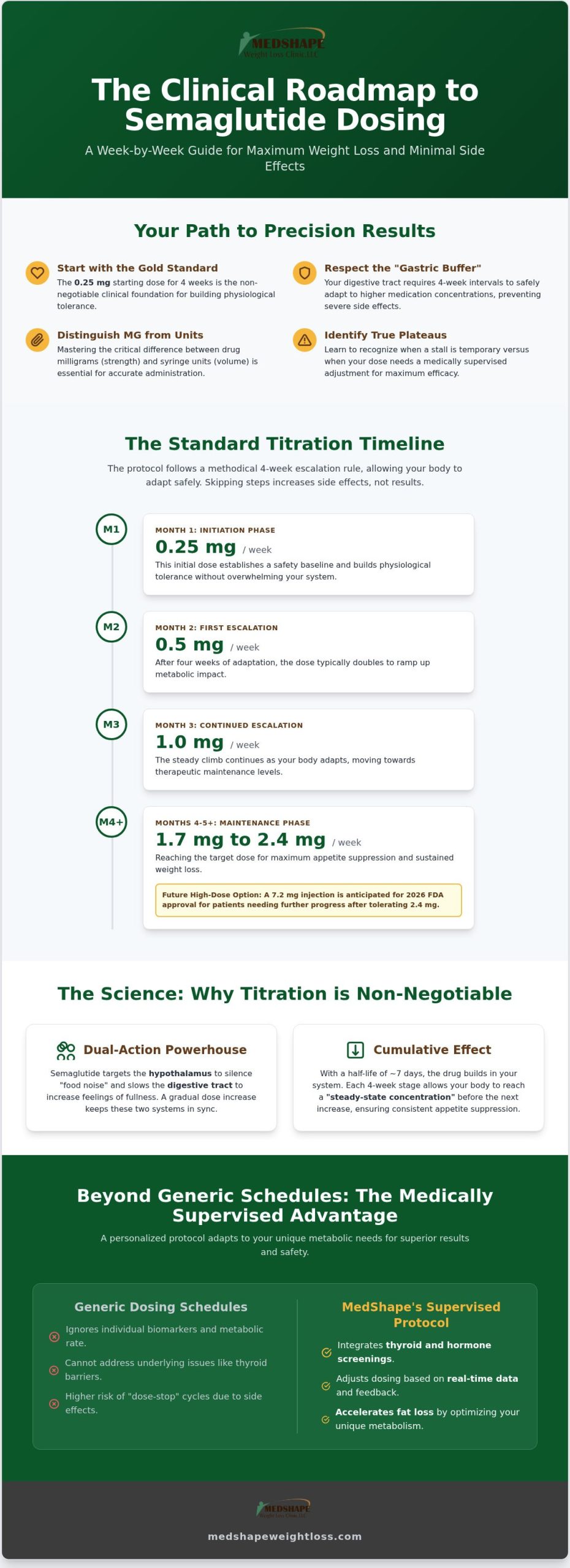
Your journey follows a methodical 4-week escalation rule. After the initial month at 0.25 mg, the protocol typically doubles to 0.5 mg in Month 2. By Month 3, most patients transition to 1.0 mg as metabolic adaptation occurs. This steady climb continues until you reach therapeutic maintenance levels. The ultimate goal is achieving maximum appetite suppression while maintaining a high quality of life. The typical roadmap looks like this:
- Month 1 (Initiation): 0.25 mg weekly to establish a safety baseline.
- Months 2-3 (Escalation): 0.5 mg and 1.0 mg doses to ramp up metabolic impact.
- Months 4-5+ (Maintenance): Reaching the 1.7 mg or 2.4 mg target doses. For patients who have tolerated the 2.4 mg dose for at least four weeks but need more progress, 2026 clinical guidelines now include a high-dose 7.2 mg injection option.
Why Clinical Supervision is Non-Negotiable
Attempting a “DIY” approach is a recipe for frustration. Rapidly jumping doses often leads to “dose-stop” cycles where side effects become so intense that patients quit. Professional oversight ensures your semaglutide dosing for weight loss is adjusted based on your specific biomarkers. At MedShape, we go beyond generic schedules by checking for the “Thyroid Barrier.” If your hormones are sluggish, even the highest dose of medication may underperform. We use blood work to determine if you need specialized thyroid weight loss support alongside your injections, ensuring every milligram of medication translates into visible results.
The Science of Titration: Why You Can’t Skip Steps
Skipping steps in your protocol isn’t a shortcut to success; it’s a direct route to metabolic rebellion. Semaglutide functions as a dual-action powerhouse, targeting the hypothalamus to silence “food noise” while simultaneously slowing down the physical movement of your digestive tract. This sophisticated interaction requires a precise clinical review of semaglutide dosing to ensure your brain and gut remain in sync. If you force a higher dose before your receptors are ready, the resulting “hormonal traffic jam” often leads to the very side effects that derail your progress.
The “Gastric Buffer” is your body’s essential adaptation period. Because semaglutide has a long half-life of approximately seven days, the medication builds up in your system over time. When you inject your second or third dose, you’re adding to the residual medication still circulating from the previous week. Steady-state concentration refers to the point where the amount of medication being eliminated from your body equals the amount being administered, ensuring consistent appetite suppression. This cumulative effect is why your semaglutide dosing for weight loss must remain static for at least four weeks at each level; your body needs that time to reach a stable internal environment before the next increase.
Managing the GLP-1 Adaptation Period
Titration is your primary defense against “the wall,” which is a sudden and severe intolerance to the medication that can cause intense GI distress. By adhering to a slow escalation, you allow your digestive enzymes and gut motility to adjust to the new “normal” of slower processing. Pushing for more medication too early doesn’t lead to faster fat loss. It often leads to dehydration and malnutrition because you’re too ill to consume the nutrients your metabolism requires to function. Patience during this phase is a clinical requirement, not a suggestion.
Metabolic Synergy: Dosing and Your Basal Metabolic Rate
As you refine your semaglutide dosing for weight loss, the medication significantly improves insulin sensitivity, allowing your body to access stored fat more efficiently. However, rapid weight loss can sometimes trigger muscle wasting if not managed correctly. We emphasize high protein intake during every dose increase to preserve lean muscle mass, which keeps your basal metabolic rate high. Understanding these nuances is part of the Semaglutide Weight Loss Pillar of health. If you want a protocol that prioritizes your long-term metabolic health over a quick fix, you can explore our customized medical packages designed for sustainable transformation.
Milligrams vs. Milliliters: Navigating Your Injection Volume
Confusion between mass and volume is the leading cause of administration errors in medical weight loss. While brand-name pre-filled pens automate the process, patients using compounded medications must master the distinction between drug mass (milligrams) and liquid volume (milliliters or units). A clinical review of semaglutide dosing emphasizes that precision is paramount; an error of just a few units can significantly alter your metabolic response. Your success depends on your ability to translate a clinical protocol into a precise physical measurement every single week.
Concentration is the critical variable that many patients overlook. Not every vial contains the same amount of medication per milliliter. If your provider changes the concentration of your supply, your volume in “units” might shift even if your actual milligram dose stays the same. This is why understanding the mechanics of your semaglutide dosing for weight loss is a critical safety skill. Always verify the mg/mL ratio on your vial label before every administration to ensure your “units” align with your prescribed milligrams.
Common Syringe Conversions for Compounded Protocols
Most clinical protocols utilize a standard U-100 insulin syringe for administration. On these syringes, “units” represent the volume of liquid, not the weight of the drug itself. For instance, 10 units on a syringe equals 0.1 mL of liquid. Whether those 10 units contain 0.25 mg or 0.5 mg of medication depends entirely on the concentration of your specific batch. We recommend using a 31-gauge needle for your injections. It’s thin enough to ensure subcutaneous comfort while maintaining the structural integrity needed for a clean, efficient delivery of the medication.
Injection Site Rotation and Dosing Efficacy
Where you inject is just as important as how much you inject. To maintain consistent semaglutide dosing for weight loss, you must rotate between the abdomen, thigh, and the back of the upper arm. Injecting into the same spot repeatedly can cause lipohypertrophy, which is the development of localized fat deposits or hardened scar tissue under the skin. This compromised tissue doesn’t absorb medication effectively, leading to erratic blood levels and wasted medication.
We advise keeping a dedicated dosing log to maintain clinical accuracy. Track the date, the specific dose in both milligrams and units, and the exact site used, such as “Left Abdomen, 2 inches from navel.” This data allows your medical supervisor to troubleshoot stalls and ensure your absorption remains optimal throughout your entire transformation journey. Professional results require professional-grade tracking.
Adjusting Your Dose Based on Results and Side Effects
Your journey with semaglutide dosing for weight loss isn’t a race to the highest milligram; it’s a search for your metabolic “sweet spot.” Many patients feel pressured to escalate every four weeks regardless of their progress, yet this often leads to unnecessary discomfort. If you are experiencing consistent appetite suppression and losing 1 to 2 pounds per week at a lower dose like 0.5 mg, there is no clinical requirement to increase it. Prioritizing comfort over rapid escalation ensures long-term adherence, which is the single greatest predictor of success in chronic weight management.
Distinguishing between a temporary stall and a true weight loss plateau is critical for making informed dosing decisions. A stall is a normal fluctuations that lasts a few days, often caused by water retention or inflammation. A true plateau is defined by four consecutive weeks without any change in weight or body measurements. For patients with extreme sensitivity, advanced strategies like dose-splitting, where the weekly amount is divided into two smaller injections, can help maintain a steady-state concentration without the “peak” that often triggers nausea. Finding your maintenance window means identifying the dose that provides maximum results with minimal lifestyle disruption.
What to Do if Side Effects Become Severe
If you experience debilitating symptoms, we utilize a “Step-Back” strategy. This involves temporarily reducing your dose to the previous level for two to four weeks to allow your system to reset. During this time, aggressive hydration and electrolyte protocols are essential, especially on injection days, to support your kidneys and digestive tract. The primary sign that you have increased your dose too quickly is persistent, severe vomiting that prevents the intake of basic nutrients or hydration. When this occurs, medical intervention is necessary to stabilize your system before resuming a more conservative titration schedule.
Managing Plateaus at the Maximum Dose
Hitting a wall at the standard 2.4 mg maintenance dose doesn’t mean your transformation is over. While the 2.4 mg level is a common therapeutic target, 2026 clinical guidelines now include high-dose 7.2 mg options for those who require additional support. We often recommend integrating Weight Loss Injections with metabolic boosters to overcome these hurdles. If semaglutide eventually reaches a point of diminishing returns, switching to a dual-action protocol like Tirzepatide may provide the necessary shift in insulin sensitivity to reignite fat loss. You can view our results-driven Semaglutide Packages to see how we customize these adjustments for every patient.
Medically Supervised Dosing: The MedShape Advantage
Generic weight loss clinics often fail because they treat every metabolism as an identical data point on a chart. At MedShape, we recognize that your semaglutide dosing for weight loss is only one component of a complex biological puzzle. We start by dismantling the “Thyroid Barrier.” If your T3 or T4 levels are suboptimal, your body will likely resist fat mobilization regardless of how much medication you inject. By identifying these hormonal roadblocks before you take your first dose, we ensure your titration schedule works in harmony with your biology rather than fighting against it.
Our protocols also integrate anti-aging peptides to address the common concerns of muscle preservation and skin elasticity during rapid transformation. These peptides function as metabolic catalysts, supporting cellular repair and collagen production while the semaglutide targets your appetite centers. This high-performance approach prevents the “depleted” look often associated with rapid weight loss. Having direct access to medical experts means you can troubleshoot your dosing in real-time. You won’t have to wait days for a response when you have questions about a specific side effect or a sudden stall in your progress.
Beyond the Injection: Our Comprehensive Protocol
We believe that medication is most effective when supported by targeted nutrition. We combine your customized injections with MedShape Elite Weight Loss Supplements to bridge any micronutrient gaps that occur as your caloric intake decreases. For patients who have struggled with weight their entire lives, our Thyroid Weight Loss Protocols provide the clinical missing link to sustainable results. This multifaceted strategy ensures that your metabolic rate stays elevated even as you reach your maintenance dose, preventing the rebound weight gain common in unsupervised programs.
Start Your Results-Driven Transformation Today
The MedShape direct-pay model removes the bureaucratic delays and limitations of insurance-based billing, allowing for faster, more personalized care. We prioritize your success through a results-oriented partnership that combines professional medical authority with the latest pharmacological advancements. Your body deserves a roadmap that is as unique as your DNA, not a photocopied schedule from a generic provider. It’s time to take control of your health with a plan designed for maximum efficiency and safety. Schedule your consultation to design your custom Semaglutide dosing plan.
Take Control of Your Metabolic Transformation
Mastering your semaglutide dosing for weight loss is the definitive step toward reclaiming your health and vitality. You’ve learned that success isn’t about rushing to the highest dose; it’s about respecting the biological titration process and ensuring every milligram translates into metabolic momentum. By understanding the critical distinction between syringe units and medication mass, you now possess the clinical confidence needed to navigate your protocol with absolute precision. Knowledge is your foundation, but professional execution is what delivers the transformation you’ve been seeking.
Information is only as powerful as the medical supervision behind it. Since 2004, MedShape has provided physician-led programs that go beyond generic schedules to offer specialized GLP-1 metabolic protocols tailored to your unique biology. We don’t just provide medication; we provide results-oriented medical supervision that identifies hormonal barriers before they stall your progress. It’s time to move past the confusion and start a program built on experience and scientific authority.
Design Your Custom Semaglutide Dosing Protocol with MedShape and start your journey toward a rapid, sustainable transformation today. You have the roadmap; now it’s time to take the first step with a partner dedicated to your success.
Frequently Asked Questions
What is the most common starting dose for semaglutide weight loss?
The standard initiation dose is 0.25 mg injected subcutaneously once per week for the first four weeks. This specific amount is designed to introduce the medication to your GLP-1 receptors without overwhelming the digestive system. While you might not see dramatic scale changes during this phase, it’s a critical safety step. Following this semaglutide dosing for weight loss baseline ensures your body is prepared for future increases without severe gastrointestinal interruption.
Can I stay on a lower dose of semaglutide if I am already losing weight?
You can absolutely remain at a lower dose if you’re achieving consistent results and maintaining appetite control. Clinical success is defined by steady fat loss, typically one to two pounds per week, rather than hitting a specific milligram target. If a lower dose like 0.5 mg or 1.0 mg is working effectively, staying there minimizes side effects and extends the longevity of your treatment plan. We prioritize your biological response over a generic schedule.
What happens if I skip a week of my semaglutide dosing schedule?
If you miss a dose, administer it as soon as you remember if it’s within five days of your scheduled date. If more than five days have passed, skip the missed dose entirely and resume your normal schedule on your next designated day. Don’t double your dose to make up for a skip. If you miss two or more consecutive weeks, contact us to determine if you need to temporarily lower your dose to prevent nausea.
How do I convert semaglutide milligrams to units on a syringe?
Conversion depends entirely on the concentration of the medication in your specific vial, which is measured in milligrams per milliliter (mg/mL). Units on a U-100 syringe measure liquid volume, while milligrams measure the drug’s mass. You must divide your prescribed dose by the concentration to find the correct volume. For example, if your concentration is 5 mg/mL and your dose is 0.25 mg, you’d draw 5 units. Always verify your vial label before every injection.
Is it better to take my semaglutide injection in the morning or at night?
Choosing between morning or evening administration is a matter of personal tolerance and lifestyle. Many patients prefer evening injections because it allows them to sleep through the initial peak of the medication, potentially avoiding early-onset nausea. Others find morning injections help them manage “food noise” more effectively throughout the day. The most important factor is consistency; try to administer your injection on the same day and at approximately the same time every week.
Will I need to increase my dose every 4 weeks indefinitely?
No, you won’t increase your dose indefinitely. The standard titration schedule typically caps at a maintenance level of 1.7 mg or 2.4 mg, though 2026 guidelines now include a 7.2 mg option for specific cases. Once you reach a dose that provides consistent weight loss and manageable side effects, you remain at that level. Your semaglutide dosing for weight loss plan is a tool to reach your goal, not a permanent ladder of escalation.
What should I do if I accidentally take too much semaglutide?
If you accidentally administer an excessive amount, contact your medical supervisor or seek emergency care immediately. Overdosing on GLP-1 medications can lead to severe, prolonged vomiting and dangerous dehydration. You should also monitor for signs of hypoglycemia, such as dizziness or confusion, although this is less common unless you’re also taking other glucose-lowering medications. Don’t wait for symptoms to peak before reaching out for professional medical guidance.
How does my thyroid health affect my semaglutide dosing needs?
Thyroid health is a primary driver of your basal metabolic rate and directly impacts how your body responds to semaglutide. If your thyroid is underactive, your weight loss may stall even at higher doses because your cellular energy production is sluggish. We screen for the “Thyroid Barrier” to ensure your hormones are optimized. This allows your medication to work at peak efficiency, often requiring more precise dosing adjustments to overcome metabolic resistance.