Skip to content

Selecting your tirzepatide injection sites is a clinical decision that directly dictates the speed of your metabolic transformation. While most patients focus only on the number on the scale, the precision of your administration technique determines whether you achieve the 22.5% average weight loss seen in clinical trials or struggle with avoidable nausea. You likely want the results without the discomfort. It’s natural to feel concerned about injection pain or inconsistent progress, especially when your goals are this ambitious.
This guide delivers the professional expertise required to master your protocol and eliminate self-administration anxiety. We are providing a definitive breakdown of FDA-approved locations and the science of site rotation to ensure maximum drug absorption. By the end of this article, you will have the confidence to manage your treatment with the same precision as a medical expert, ensuring every dose moves you closer to your ideal physique. You deserve a weight loss journey that is as efficient as it is effective.
Key Takeaways
- Identify the three FDA-approved tirzepatide injection sites to ensure medication is delivered into subcutaneous fat for an optimal metabolic response.
- Learn how to strategically select your injection location to potentially mitigate common gastrointestinal side effects such as nausea.
- Master clinical preparation and administration steps, including proper sanitization and the elimination of air bubbles for a pain-free experience.
- Discover the critical importance of site rotation to prevent lipohypertrophy, a condition where scar tissue buildup can severely hinder medication absorption.
- Understand why physician-monitored protocols are essential for adjusting dosages and maximizing your individual weight loss results safely.
FDA-Approved Tirzepatide Injection Sites: Where to Administer Your Dose
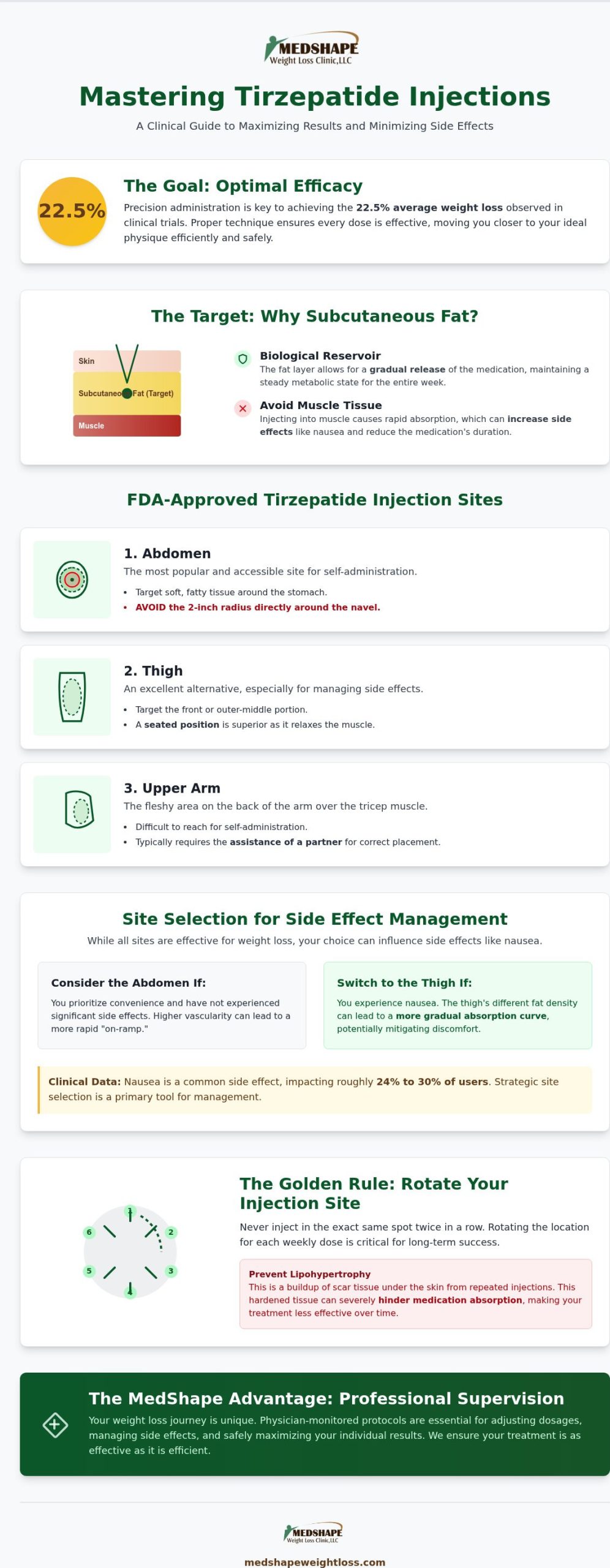
Precision is the hallmark of an elite weight loss protocol. As you begin your journey with tirzepatide, understanding the geography of your body is just as vital as the dosage itself. The efficacy of this medication depends entirely on its delivery into the correct anatomical layer. There are three primary tirzepatide injection sites approved for administration: the abdomen, the thigh, and the back of the upper arm. Each site offers a unique profile for absorption and ease of use, and mastering them is the first step toward achieving professional-grade results.
Why Subcutaneous Fat is the Target
Tirzepatide is engineered for subcutaneous administration, meaning it must be deposited into the fatty layer of tissue just below the skin. This fatty layer acts as a biological reservoir. It allows the medication to be released gradually into the systemic circulation, maintaining the steady metabolic state required for rapid fat loss. If you accidentally inject into muscle tissue, the drug absorbs far too quickly. This rapid uptake not only increases the risk of acute side effects like intense nausea but also prevents the medication from lasting the full week. Subcutaneous tissue is simply the layer of fat located directly between your skin and your underlying muscle.
Visualizing the Injection Zones
Successful administration requires more than just picking a spot; it requires identifying safe zones that maximize comfort and drug bioavailability. At MedShape, we prioritize these specific areas to ensure our patients maintain the highest standards of safety and efficacy.
- The Abdomen: This is the most popular choice for self-administration due to its accessibility. You must target the area around your stomach while strictly avoiding the two-inch radius immediately surrounding your navel. This ensures you are hitting soft adipose tissue rather than tougher connective structures or larger blood vessels.
- The Thigh: Target the front or the outer-middle portion of your thigh where the fat is most accessible. Many patients find that a seated position is superior for this site because it allows the leg muscle to relax, making it easier to pinch the necessary subcutaneous fat and reduce the chance of an accidental intramuscular injection.
- The Upper Arm: This site is located in the fleshy area on the back of the arm, specifically over the tricep. Because of the angle required to reach this area, this location typically requires the assistance of a partner or healthcare professional to ensure the needle is placed correctly.
While all three tirzepatide injection sites are considered equally effective for medication absorption, your choice may depend on your personal comfort level and whether you have assistance. Choosing the right zone is a strategic decision that sets the tone for your entire metabolic transformation.
Optimizing Results: Does the Injection Site Affect Weight Loss or Nausea?
The debate over the “best” location for your dose often centers on the trade-off between rapid results and manageable side effects. Clinical consensus states that absorption is statistically similar across all approved zones. Yet, many high-performance patients notice that the abdomen, while convenient, can sometimes trigger more intense initial responses. This is likely due to the higher concentration of blood vessels in the abdominal wall, which facilitates a more aggressive entry of the medication into your system. Understanding this dynamic allows you to manipulate your protocol based on how your body reacts each week. All tirzepatide injection sites are viable, but your personal sensitivity should dictate your rotation.
Site Selection for Side Effect Management
Nausea remains the most reported hurdle for those on this journey, impacting roughly 24% to 30% of users according to clinical data. If you find yourself sidelined by morning-after discomfort, shifting your focus to the thigh may be a strategic move. The outer thigh generally possesses a different fat density and lower vascularity than the stomach, which can lead to a more gradual absorption curve. While the drug eventually reaches the same systemic levels, this slower “on-ramp” can make a world of difference in your daily quality of life. We encourage our clients to maintain a detailed journal, noting which tirzepatide injection sites were used and the subsequent intensity of any side effects. If these challenges persist, exploring our Tirzepatide Packages ensures you have a medical partner to help fine-tune your administration strategy.
Absorption Consistency and Metabolic Impact
Despite what social media trends might suggest, “spot reduction” is a biological impossibility with this medication. Tirzepatide functions as a dual-action agonist, targeting receptors in the brain and gut to regulate hunger and metabolic rate globally. Injecting into a specific area won’t accelerate fat loss in that localized region. Your goal is systemic saturation, which is achieved through consistent weekly dosing. Ultimately, the total volume of medication in your system over time is the metric that drives the 22.5% average weight loss seen in clinical studies. Focus on the integrity of your injection technique and the consistency of your schedule rather than searching for a “magic” spot. Your long-term transformation depends on a stable, well-managed protocol.
Step-by-Step Guide: How to Inject Your Tirzepatide Protocol
Mastering the clinical mechanics of self-administration is the final bridge between your current state and your metabolic goals. While the process may seem daunting initially, it is a straightforward skill that ensures the integrity of your treatment. Precision in delivery is non-negotiable for success. By following a structured, sterile methodology, you transform a routine task into a professional-grade medical procedure that maximizes fat loss while protecting your skin health. Every dose is an opportunity to reinforce your commitment to a rapid transformation.
Preparation begins with a sterile environment. Always wash your hands thoroughly before handling your supplies. You must sanitize both the rubber stopper of the vial and your chosen tirzepatide injection sites with a fresh alcohol swab. This step is critical to prevent surface bacteria from entering the injection tract. Once the site is prepared, draw your prescribed dose by pulling the plunger back to the exact unit marker. If you notice air bubbles, tap the side of the syringe firmly until they rise to the top, then push the plunger slightly to expel them. An air-free syringe ensures you receive the full therapeutic volume of your medication.
Handling a Vial and Syringe with Confidence
Most compounded protocols utilize insulin-style syringes, which feature much finer needles than traditional equipment. These syringes are calibrated in units, and reading the markings with total accuracy is vital for maintaining your specific dosage schedule. When you are ready to inject, aim for a 90-degree angle relative to the skin surface. This perpendicular entry is standard for most patients. However, if you possess a very low body fat percentage, a 45-degree angle may be more appropriate to ensure the needle remains within the subcutaneous layer and does not reach the muscle. This technical nuance is part of the professional guidance we provide to ensure your comfort and safety.
While syringes are the standard for many protocols, the field is evolving toward more convenient delivery methods; for instance, ReadyPep offers pre-filled research pens that streamline the process and ensure dosage precision.
Minimizing Injection Site Reactions
Discomfort is often the result of poor timing rather than the needle itself. To eliminate the common “stinging” sensation, allow the alcohol to dry completely on your skin for at least 15 to 30 seconds before making contact. Additionally, taking the medication out of the refrigerator 15 minutes prior to use allows it to reach room temperature, which significantly reduces the pressure sensation during the injection. After the needle is withdrawn, resist the urge to rub the area vigorously. Rubbing can irritate the tissue and cause unnecessary bruising. Instead, apply light pressure with a clean cotton ball if needed. While minor redness at tirzepatide injection sites is a normal localized response, any signs of systemic hives or swelling should be reported to your clinical supervisor immediately.
The Importance of Site Rotation: Preventing Scar Tissue
Site rotation isn’t just a suggestion; it’s a clinical requirement for maintaining the long-term efficacy of your treatment. If you inject into the same localized area repeatedly, you risk developing a condition known as lipohypertrophy. This is the accumulation of hardened fatty tissue or scar tissue caused by repetitive micro-trauma to the subcutaneous layer. Because scar tissue is poorly vascularized, it acts as a physical barrier to medication absorption. You might be administering the correct dose, but if the tissue is compromised, your body won’t receive the full metabolic benefit. Preserving the integrity of your tirzepatide injection sites is essential to ensuring that every milligram of your protocol is working at maximum capacity.
The “one-inch rule” is your primary defense against tissue fatigue. You must ensure that each new injection is placed at least one inch away from the previous week’s entry point. A highly effective strategy is the “Clockwork Rotation” method within a single zone. Imagine a clock face on your abdomen; if you inject at the 12 o’clock position one week, move to the 3 o’clock position the next. This systematic approach ensures that no single area of tissue is overused while you remain within the designated safe zones for administration.
Creating a Weekly Rotation Schedule
A structured 4-week rotation cycle is the professional standard for avoiding lipohypertrophy. We recommend a sequence that utilizes all available zones to give each area ample time to recover. For example, your schedule could move from the left abdomen to the right abdomen, then to the left thigh, and finally the right thigh. Using a digital log or a physical calendar to track these locations prevents the guesswork that often leads to repetitive site use. Before each dose, physically palpate the area. If you feel any “hard spots” or firm nodules under the skin, it’s a sign that the tissue needs a prolonged rest period.
When to Retire an Injection Site
Tissue fatigue can manifest as persistent bruising that doesn’t heal within a week or localized lumps that remain tender. If you notice these signs, you must retire that specific site for at least 4 to 6 weeks. This recovery period allows the subcutaneous fat to heal and the localized inflammation to subside. If you are concerned about persistent skin changes or need a more structured approach to your administration, our Tirzepatide Packages provide the medical oversight necessary to optimize every aspect of your journey. You should consult your MedShape physician immediately if you notice any skin thickening, significant discoloration, or signs of infection at your tirzepatide injection sites.
The MedShape Advantage: Professional Supervision for Your Protocol
Navigating a medical weight loss journey requires more than just a map of tirzepatide injection sites; it requires an expert navigator. While the mechanics of administration are vital, the biological response to the medication is highly individualized. Attempting to self-prescribe or follow unmonitored protocols introduces significant risks to your metabolic health. Without professional oversight, you lack the diagnostic tools to differentiate between normal adjustment periods and adverse reactions that require immediate dosage modification. We provide the clinical authority necessary to ensure your journey is safe, structured, and successful.
MedShape operates on a direct-pay model, which eliminates the bureaucratic hurdles often associated with insurance-based billing. This allows us to focus entirely on your results rather than administrative red tape. Our protocols are designed to be agile. We monitor your progress in real-time, adjusting your dosage based on your specific side-effect profile and rate of fat loss. By integrating tirzepatide into a broader, thyroid-aware metabolic plan, we address the root causes of weight gain that many generic programs overlook. Since 2004, we’ve refined these supervised protocols to ensure that your metabolic rate remains elevated even as your caloric intake decreases.
Customized Tirzepatide Packages
Our physician-led approach to Tirzepatide Packages goes beyond the simple act of writing a prescription. We specialize in compounded GLP-1 and GIP therapies that are tailored to your unique physiology and weight loss history. This includes a strategic transition from the initial loading dose to a personalized maintenance dose, ensuring your body adapts without stalling or experiencing unnecessary discomfort. Alongside the medication, we provide comprehensive nutritional support and metabolic monitoring to protect lean muscle mass while you shed adipose tissue. This holistic oversight is what separates a temporary fix from a permanent lifestyle transformation. We prioritize your long-term vitality by ensuring your hormones and metabolic markers stay in perfect alignment throughout the process.
Ready for Transformation?
The time for guessing is over. Every week spent on an unoptimized protocol is a week of lost progress. You already have the knowledge of the correct tirzepatide injection sites and the importance of rotation; now you need the professional partnership to bring it all together. Our team has been delivering medically supervised protocols for over two decades, and we are ready to apply that expertise to your individual success. Experience the speed and efficiency of a program designed by innovators in the field who are committed to your rapid transformation. Start your results-oriented Tirzepatide journey with MedShape today.
Take Command of Your Metabolic Transformation
Mastering the selection of your tirzepatide injection sites is the foundation of a high-performance weight loss strategy. By utilizing the abdomen, thigh, or upper arm and implementing a strict rotation schedule, you protect your subcutaneous tissue from scar tissue and ensure consistent medication absorption. These technical details are the difference between stagnant results and the rapid transformation you deserve. However, technique alone isn’t enough. You need the expertise of a clinical partner to navigate dosage adjustments and metabolic roadblocks.
MedShape has provided medically supervised protocols since 2004, specializing in thyroid-specific and metabolic strategies that deliver proven results. We don’t just provide medication; we provide a comprehensive roadmap to your goal weight. Stop guessing about your administration and start a protocol backed by two decades of leadership in medical weight loss. Your elite transformation starts today.
Claim your specialized Tirzepatide Weight Loss Package now and take the first step toward a leaner, more energetic future.
Frequently Asked Questions
What is the single best place to inject tirzepatide for weight loss?
All three FDA-approved tirzepatide injection sites are considered clinically equivalent regarding total weight loss efficacy. While the abdomen is the most common choice due to ease of access, the “best” site is the one that allows you to maintain a consistent, pain-free schedule. Success depends on your technique and adherence to the protocol rather than a specific anatomical location.
Can I inject tirzepatide in the same spot every week?
No. You must rotate your injection location every week to maintain tissue integrity. Use the one-inch rule, ensuring each new dose is at least one inch away from the previous week’s site. Constant repetition in one spot leads to scar tissue, which eventually blocks the medication from entering your system effectively.
What happens if I accidentally inject tirzepatide into muscle?
Intramuscular injection causes the medication to absorb into your bloodstream much faster than intended. This rapid uptake disrupts the slow-release metabolic curve and often leads to a sharp increase in gastrointestinal side effects like nausea. While not typically a medical emergency, it compromises the efficiency of your weekly protocol.
Does the injection hurt more in the stomach or the thigh?
Pain perception is subjective, but many patients report that the abdomen is the least painful due to the higher density of subcutaneous fat. The thigh can feel more sensitive if the needle is placed too close to the muscle or if the skin is not properly pinched. Relaxing your muscles before the poke is the key to a painless experience.
How do I know if I’ve developed scar tissue from my injections?
You can identify lipohypertrophy by palpating the area and feeling for firm, rubbery nodules or “hard spots” beneath the skin surface. If you notice that your tirzepatide injection sites feel significantly denser than the surrounding tissue, it is a clear indication that the area requires a prolonged rest period. Ignoring these signs leads to poor medication absorption and stalled progress.
Can I inject tirzepatide while it is still cold from the refrigerator?
Yes, you can, but it is not recommended for maximum comfort. Injecting cold liquid often causes a sharp stinging sensation and increased localized pressure. We advise letting the medication sit at room temperature for approximately 15 minutes to ensure a much smoother and more comfortable administration process.
Should I massage the area after my tirzepatide injection?
No. You should never massage or vigorously rub the site after administration. Massaging the area can irritate the subcutaneous tissue, increase the likelihood of bruising, and potentially interfere with the medication’s intended absorption rate. If you see a tiny drop of blood, simply apply light, steady pressure with a clean cotton ball.
Is it normal to see a small drop of blood or medicine after injecting?
Yes. Seeing a small bead of blood or a tiny droplet of clear liquid at the site is perfectly normal and does not mean you have lost your dose. This usually happens if a small capillary was nicked or if the needle was withdrawn too quickly. It does not impact the overall efficacy of your metabolic treatment.