Skip to content


Last Updated: November 6, 2026
Quick Summary
Tirzepatide dosing for weight loss is prescribed in milligrams, but you draw it in units, so the unit number depends on your vial’s concentration. Use units = (mg ÷ mg/mL) × 100 on a standard U-100 syringe, then confirm the result with your prescriber or pharmacist before injecting.
- Check the mg/mL concentration on your vial label before drawing any dose.
- Apply the formula: milligrams divided by concentration gives mL, and mL multiplied by 100 gives units.
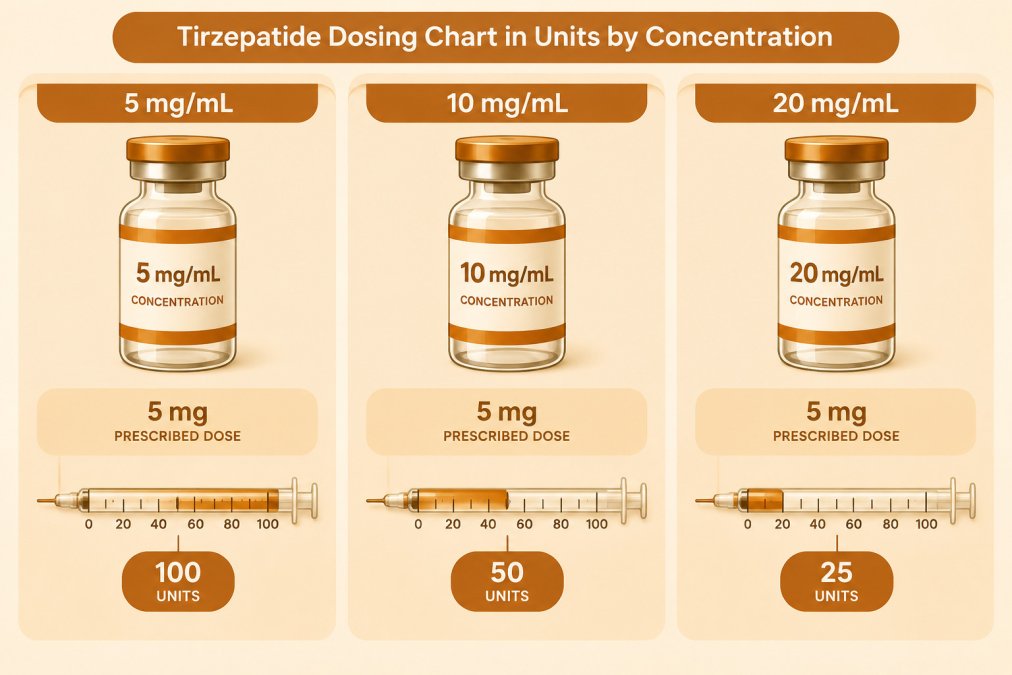
- A 5 mg dose is 25 units at 20 mg/mL but 50 units at 10 mg/mL.
- Doses above 100 units exceed a standard 1 mL syringe, so confirm the syringe size with your pharmacist.
- If units, concentration and prescription do not match, do not inject; contact your prescriber first.
Table of Contents
- Why Tirzepatide Doses Are Measured in Milligrams but Drawn in Units
- Tirzepatide Dosing Chart in Units by Concentration
- How Many mg Is 20 Units of Tirzepatide?
- Tirzepatide Dosing for Weight Loss in mL and Syringe Volume
- Using a Tirzepatide Dosage Calculator Safely
- Missed Doses, Dose Escalation, and When Units Are Unclear
- Confirming Your Tirzepatide Dose With Your Prescriber
- Frequently Asked Questions
Tirzepatide dosing for weight loss in units is one of the most confusing parts of starting treatment, and for good reason. Your prescription is written in milligrams, but the syringe you hold is marked in units. That gap is where most dosing mistakes happen. This guide walks through how the conversion works, what the common doses look like on a syringe, and what to do when something doesn’t add up.
Why Tirzepatide Doses Are Measured in Milligrams but Drawn in Units
Tirzepatide dosage is prescribed in milligrams (mg), the amount of active drug in each injection. A syringe, however, measures volume, not drug amount. That is why the same dose can look like a different number of units depending on the medication’s concentration.
Think of it like a bottle of concentrated juice. Two bottles can hold the same amount of flavor, yet one needs more liquid to deliver it. The same logic applies here. A more concentrated vial means fewer units for the same milligram dose.
Because of this, the unit number alone tells you nothing until you know the concentration on your label. Always check the mg/mL figure before you draw any dose.
Tirzepatide Dosing Chart in Units by Concentration
Dosing is set by the prescriber, who typically increases the dose in steps as you tolerate it. Your prescription and care plan state the milligram dose you should follow. None of those numbers tell you how many units to draw until you know the concentration printed on your vial.
The formula is the same every time: milligrams divided by concentration (mg/mL) equals milliliters, and milliliters multiplied by 100 equals units on a standard U-100 insulin syringe. Written as one line: units = (mg ÷ mg/mL) × 100. For the practical injection steps once you have your units, see weekly injection steps.
Here is that formula worked out at several example concentrations. Every number below is an example of the math, not an individualized dosing instruction.
| Prescribed Dose | Units at 20 mg/mL | Units at 17.5 mg/mL | Units at 10 mg/mL | Units at 5 mg/mL |
|---|---|---|---|---|
| 2.5 mg | 12.5 units | ~14.3 units | 25 units | 50 units |
| 5 mg | 25 units | ~28.6 units | 50 units | 100 units |
| 7.5 mg | 37.5 units | ~42.9 units | 75 units | 150 units (1.5 mL) |
| 10 mg | 50 units | ~57.1 units | 100 units | 200 units (2 mL) |
| 12.5 mg | 62.5 units | ~71.4 units | 125 units (1.25 mL) | 250 units (2.5 mL) |
| 15 mg | 75 units | ~85.7 units | 150 units (1.5 mL) | 300 units (3 mL) |
Worked examples, step by step:
- 5 mg at 10 mg/mL. 5 ÷ 10 = 0.5 mL. 0.5 × 100 = 50 units.
- 5 mg at 20 mg/mL. 5 ÷ 20 = 0.25 mL. 0.25 × 100 = 25 units.
- 2.5 mg at 5 mg/mL. 2.5 ÷ 5 = 0.5 mL. 0.5 × 100 = 50 units.
- 15 mg at 17.5 mg/mL. 15 ÷ 17.5 ≈ 0.857 mL. 0.857 × 100 ≈ 85.7 units, which rounds to about 86 units on a 1-unit-marked syringe.
Notice what the table makes obvious: a 5 mg dose is 25 units on one vial and 100 units on another. The milligram dose never changes with concentration, but the unit volume does. That is why there is no single universal conversion for tirzepatide, and why any chart that gives one number per milligram dose without naming a concentration should be treated as incomplete.
Two practical consequences follow. First, doses above 100 units exceed a standard 1 mL U-100 syringe, so a larger dose may require a different syringe or a split draw that your prescriber has approved. Second, when the calculated volume lands between tick marks, do not round to the nearest “close enough” number without confirming with your pharmacist which syringe size and rounding convention your prescription assumes.
Watch out: if the concentration on your vial label does not match the concentration in the chart you are using, stop and recalculate from the label, do not scale the units up or down by feel.
How Many mg Is 20 Units of Tirzepatide?
The answer depends entirely on concentration. To convert units to milligrams, multiply the number of units by the concentration in mg/mL, then divide by 100 for a standard U-100 insulin syringe, which holds 100 units per milliliter.
Here is the simple version: units divided by 100 gives milliliters, and milliliters multiplied by concentration gives milligrams.
Using the chart above, 20 units at 2.5 mg/mL works out to 0.2 mL, which delivers 0.5 mg. At 5 mg/mL, 20 units equals 0.2 mL and delivers 1 mg. At 10 mg/mL, 20 units delivers 2 mg. The same 20 units produces very different doses, which is why the concentration matters so much.
If you are ever unsure what 20 units means for your vial, ask your prescriber or pharmacist to write the milligram amount on your dosing card.
Tirzepatide Dosing for Weight Loss in mL and Syringe Volume
Many prescriptions list the dose in milliliters instead of units. A milliliter is the same volume as 100 units on a standard U-100 insulin syringe, so 0.5 mL equals 50 units and 0.25 mL equals 25 units. That 100-units-per-mL relationship is fixed by the syringe, not by the drug, which is why the same milliliter volume can carry very different milligram amounts depending on concentration.
Three quantities get confused constantly, and separating them resolves most dosing errors:
- Milligrams (mg), the amount of active drug your prescriber ordered. This is the dose.
- Concentration (mg/mL), how much drug is dissolved in each milliliter of the vial. This is the label number.
- Milliliters (mL) and units, the volume you draw. This is what the syringe measures.
A U-100 insulin syringe is built so that 100 units fill 1 mL. On a 1 mL barrel, each small tick is 1 unit (0.01 mL), the halfway mark is 50 units (0.5 mL), and the full barrel is 100 units (1 mL).
That is the practical reason to match syringe capacity to dose size. Once the prescribed dose is measured accurately, keeping protein intake guidelines in mind can help make nutrition part of a broader approach to weight management.
Use this order every time:
- Find the prescribed milligram dose on your prescription.
- Check the concentration (mg/mL) on the vial or pharmacy label.
- Calculate the volume: milligrams divided by concentration equals mL.
- Convert mL to units by multiplying by 100.
- Confirm the result fits your syringe capacity, then draw exactly that many units and double-check before injecting.
Reading the barrel correctly matters as much as the math. Hold the syringe with the needle pointing up at eye level, keep the plunger tip, not the liquid line, aligned with the mark you are reading, and account for any air bubble before you judge the volume. Expel air, re-check, and only then inject. Good lighting and a steady surface beat guessing at a tilted barrel.
Watch out: units are not milligrams and not milliliters. A “20 unit” instruction is a volume, and it only becomes a dose once you multiply by your vial’s concentration, treating 20 units as if it meant 20 mg, or as if it meant 0.2 mg on every vial, is the single most common conversion mistake.
Using a Tirzepatide Dosage Calculator Safely
Dosage calculators can help you check your math, but they are only as accurate as the numbers you enter. A calculator cannot tell whether your label is correct or whether your prescribed dose is right for you.
Use a calculator as a double-check, not a replacement for your prescription. Enter the exact concentration printed on your vial, the milligram dose from your prescriber, and confirm the units match your syringe type. If the result does not match the chart in your care plan, stop and call your provider before injecting.
Never rely on a calculator from a social media post, a forum, or an unverified website. Use a tool provided by your clinic or pharmacy, or work the math by hand as shown above.
Missed Doses, Dose Escalation, and When Units Are Unclear
Missed doses happen, and the right response depends on how many days have passed since your scheduled injection. Follow the guidance your prescriber gave you. The window for a late dose varies, so confirm the timing with your provider rather than guessing.
Dose escalation is also planned in steps. Do not move to a higher dose early, even if you feel you can handle it. Increase only when your prescriber instructs you to, and update your unit calculation for the new milligram dose.
If the units on your syringe, the concentration on your label, and your prescription do not agree, do not inject. Contact your prescriber or pharmacy first. Unclear dosing is one of the most common causes of errors, and a short phone call is far safer than a guess.
Confirming Your Tirzepatide Dose With Your Prescriber
Your prescriber is the final check on every dose. Before you start, and any time your dose changes, confirm three things: the milligram dose, the vial concentration, and the unit or mL amount you should draw.
Ask your provider to write all three on your dosing card. Bring that card to every appointment and keep a copy at home. To weigh results and safety independently, read this independent treatment review.
If you have questions about your specific dose, contact a qualified prescriber before you inject. Your provider can confirm the right amount for your health history and current treatment plan.
Frequently Asked Questions
What is 25 units of tirzepatide equal to?
The answer depends on the concentration printed on your vial or prescription label, because a unit is a syringe marking, not a fixed amount of medication. Compounded tirzepatide can be prepared in several concentrations, so 25 units could equal a different milligram dose at each one. Divide the dose you were prescribed in milligrams by the concentration in mg/mL to find the volume in mL, then multiply by 100 to convert to units on a U-100 insulin syringe. Confirm the calculation with your prescribing clinician before injecting.
How many milligrams of tirzepatide are in 20 units?
Twenty units equals 0.2 mL on a U-100 insulin syringe. To find the milligram amount, multiply 0.2 mL by the concentration on your label in mg/mL. For example, at 2.5 mg/mL, 20 units delivers 0.5 mg, while at 10 mg/mL it delivers 2 mg. Because the concentration varies by pharmacy and prescription, never assume a conversion without checking the label. If the label is unclear, contact your prescriber or pharmacy before the next injection.
Can tirzepatide units be converted to milligrams without knowing the concentration?
No. A unit measures volume, so the same number of units can represent very different doses depending on how much tirzepatide is dissolved in each milliliter. The concentration on the vial or prescription label is required for any accurate conversion. Without it, a conversion would be a guess, and guessing can lead to a dangerous overdose or an underdose. Ask your prescribing clinic to state the mg/mL concentration in writing.
Is 10 units of tirzepatide a lot?
Ten units is 0.1 mL on a U-100 insulin syringe, and whether that is a large or small dose depends entirely on the concentration. At 2.5 mg/mL it delivers 0.25 mg, while at 5 mg/mL it delivers 0.5 mg. Dose increases are set by your prescriber, so the appropriate number of units changes as your prescribed dose changes. Your prescriber sets the target dose, not the unit count alone.