Skip to content


Quick Summary
Compounded GLP-1s are custom-mixed drugs that are not the same as FDA-approved semaglutide or tirzepatide, and they generally lack the safety, effectiveness, and quality review of approved products. Without medical supervision, risks include dosing errors, unmanaged side effects, batch-to-batch quality problems, and counterfeit products.
- Compounded GLP-1s are not reviewed by the FDA for safety, effectiveness, or quality.
- Dose strength can vary because the pharmacy mixes the active ingredient itself.
- Verify the pharmacy’s state license and the patient-specific prescription before paying.
- Tell your prescriber about pancreatitis, gallbladder, or thyroid history and family thyroid cancer.
- Pause before the next dose and contact a clinician or pharmacist if you have an unverified product.
Table of Contents
- What Compounded GLP-1 Medications Are and How They Differ From FDA-Approved Drugs
- FDA Status, Shortages, and When Compounding May Be Permitted
- compounded GLP-1 vs non compounded: Key Differences in Safety and Quality
- Risks of Unsupervised Use: Dosing Errors, Side Effects, and Product Quality
- compounded GLP-1 effectiveness: What the Evidence Does and Does Not Show
- How to Spot Inadequate Clinician Oversight: A Practical Checklist
- compounded GLP-1 reviews and the Latest ban update: What Patients Should Check Before Starting
- Your Next Step: Booking a Medically Supervised Consultation
- Frequently Asked Questions
What Compounded GLP-1 Medications Are and How They Differ From FDA-Approved Drugs
Last Updated: November 14, 2026
Compounded GLP-1 medications are custom-mixed drugs made by a pharmacy for an individual patient. They are not the same as the FDA-approved versions of semaglutide or tirzepatide sold under brand names.
A compounded GLP-1 is a drug that a licensed pharmacy mixes based on a prescriber’s order. The mix may change the dose, the form, or the added ingredients.
Here is the core difference:
- FDA-approved drugs are reviewed before they reach patients for safety, effectiveness, and quality.
- Compounded drugs are made for a specific patient and are not reviewed by the FDA for those three things.
- Compounded products may vary in strength, purity, and sterility from batch to batch.
The compounding rules sit mainly in the Federal Food, Drug, and Cosmetic Act. The FDA’s guidance on concerns with unapproved GLP-1 drugs used for weight loss explains that compounded versions are not approved drugs.
FDA Status, Shortages, and When Compounding May Be Permitted
Compounding is not illegal in every case.
Shortages changed the picture for a while. Compounding rules tied to drug shortages have changed over time. Check the FDA’s current shortage listings and guidance for the rules that apply today.
Check the official status before you start. Look for:
- Whether the FDA has listed the drug as in shortage or as resolved
- Whether your prescriber can name a documented medical reason for a compounded version
- Whether the pharmacy is state-licensed and inspected
For the current rules, the FDA drug shortage list and compounding guidance is the place to check.
compounded GLP-1 vs non compounded: Key Differences in Safety and Quality
Compounded and non-compounded GLP-1 medications differ in ways that affect your safety.
Compounded versions depend on the pharmacy’s own process, its state license, and the prescriber’s judgment. A mistake in mixing can change the dose you actually receive.
Key differences include:
- Dose accuracy: Approved products have a fixed, tested strength printed on the label. Compounded doses can vary because the pharmacy measures and mixes the active ingredient itself. Concentration differences between two vials of the same labeled strength are a known source of dosing error.
- Sterility: Compounding errors can introduce contamination. Injectable products carry a higher bar because anything non-sterile goes straight into tissue.
- Oversight: Approved drugs follow a labeled prescribing pathway with a published titration schedule. Compounded drugs often depend on the prescriber’s judgment alone, and that judgment may come from a questionnaire rather than a conversation.
A Yale School of Medicine secret-shopping study of online GLP-1 access found that 92% of websites prescribed GLP-1 medications and 69% mailed them, with little to no clinician oversight.
How to verify a pharmacy and the prescription pathway
A legitimate compounded GLP-1 arrives through a specific chain: a licensed prescriber evaluates you, issues a patient-specific prescription, a state-licensed pharmacy compounds it, and the pharmacy dispenses it with a label that names the patient, the drug, the strength, the beyond-use date, and the pharmacy’s contact information.
Use these checks before you pay:
- Confirm the pharmacy’s license. Every state board of pharmacy publishes a license lookup. Search the pharmacy’s name and the state where it compounds. If the seller will not name the pharmacy, that is a stopping point.
- Confirm the prescription is patient-specific. Ask who wrote it, what state they are licensed in, and whether they reviewed your history. A prescription issued without any clinician contact is a red flag, not a convenience.
- Read the vial label. It should show your name, the drug name, the strength, the lot number, the beyond-use date, and storage instructions. Missing elements mean missing quality control.
- Distinguish the pharmacy from the seller. Many online storefronts are marketers, not pharmacies. The pharmacy that compounds the drug should be identifiable and licensed.
- Check the FDA shortage status. If the drug is not in shortage and no documented medical reason supports a compounded version, the legal basis for compounding is weak.
Watch out: a seller that offers a “consultation” that is only a checkbox form, then ships a vial without ever naming the pharmacy or the prescriber, has skipped the parts of the pathway that protect you.
Risks of Unsupervised Use: Dosing Errors, Side Effects, and Product Quality
Using a compounded GLP-1 without real medical supervision creates several specific risks. Here are the main ones:
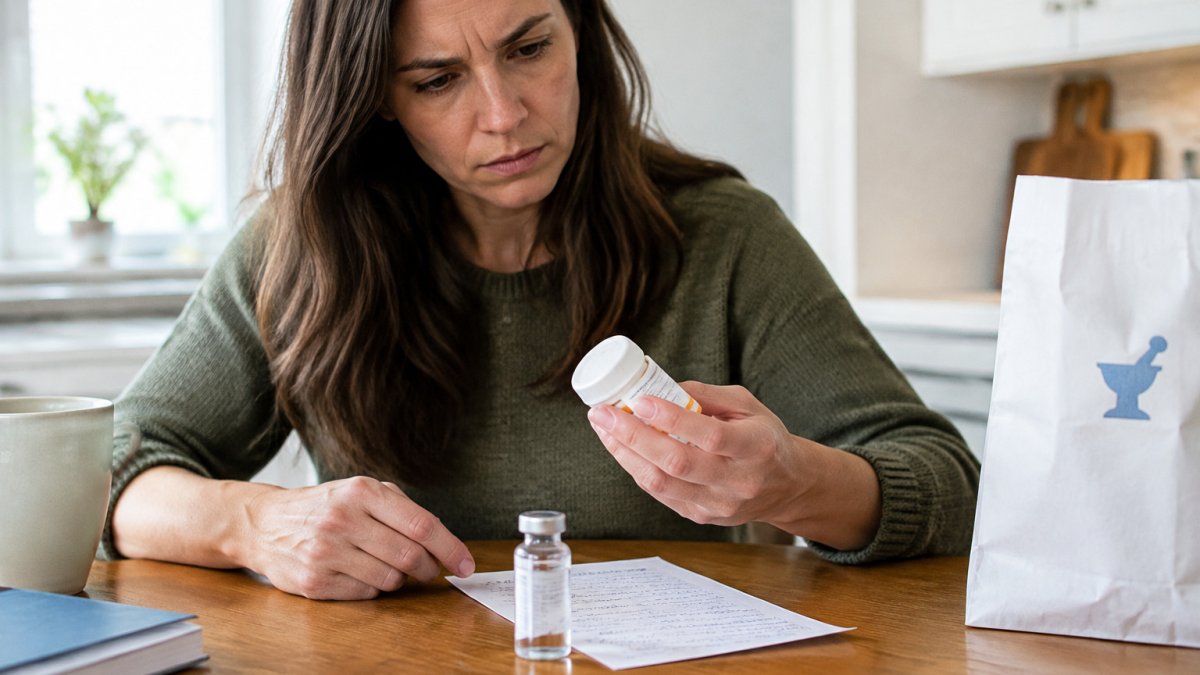
- Dosing errors. Dose escalation is gradual with these drugs. Without a clinician checking your progress, a wrong step can go unnoticed.
- Unmanaged side effects. Nausea, vomiting, and digestive problems are common. Without follow-up, serious reactions may not be caught early.
- Product quality problems. Potency, purity, and sterility can differ from one batch to the next.
- Counterfeit or mislabeled products. Unverified sellers may sell products that do not match their labels.
- Missed health screening. A clinician reviews your history for conditions that make these drugs risky.
Who Faces Higher Risk and What to Disclose
Some people face higher risk and should tell their prescriber before starting. Be open about:
- Any history of pancreatitis or gallbladder problems
- Thyroid conditions, including a family history of thyroid cancer
- Diabetes medications you already take
The main risks of using a compounded GLP-1 without real medical supervision are summarised below.
| Risk | What it looks like | Why it matters |
|---|---|---|
| Dosing errors | Gradual escalation goes unchecked | A wrong step can go unnoticed |
| Unmanaged side effects | Nausea, vomiting, digestive problems | Serious reactions may not be caught early |
| Product quality problems | Potency, purity, sterility vary by batch | Batches may differ from one another |
| Counterfeit or mislabeled products | Product does not match its label | Unverified sellers may misrepresent contents |
| Missed health screening | No clinician reviews your history | Conditions that make these drugs risky go missed |
compounded GLP-1 effectiveness: What the Evidence Does and Does Not Show
Most of the strong effectiveness data comes from studies of FDA-approved drugs, not compounded versions. That is a key limit.
A peer-reviewed review of compounded GLP-1 access and adverse events reports that the FDA and other public health agencies had logged more than 1,000 adverse events linked to compounded GLP-1 formulations as of mid-2025.
So what does the evidence show? Approved GLP-1 drugs have been studied in clinical trials. Compounded versions generally have less direct testing, so results from approved products cannot be assumed to apply to them.
How to Spot Inadequate Clinician Oversight: A Practical Checklist
Use this checklist before you start any compounded GLP-1 program. Each item explains what a good answer looks like and what a bad one signals, so you can tell the difference between real oversight and a storefront that only looks clinical.
- Did a licensed clinician review your full medical history? A real review covers prior weight-loss attempts, pancreatitis or gallbladder history, thyroid conditions including family history of thyroid cancer, kidney issues, and current medicines. A form that asks only your weight and goal is not a medical history.
- Did the clinician ask about your current medicines and conditions? GLP-1 drugs interact with diabetes medications, some antidepressants, and drugs that affect gastric emptying. If nobody asked, nobody checked.
- Is there a scheduled follow-up with a clinician, not just a support chat? Appropriate care includes a titration plan and a check-in after you start. A chat bot or a general support inbox is not follow-up.
If you answered no to several of these, treat that as a warning sign. Two or more no answers is a reason to pause before you pay.
What to do after receiving or using an unsupervised product
If you already have a compounded GLP-1 from a seller you cannot verify, or you have already used one, take these steps in order:
- Pause before the next dose. Do not increase your dose or start a new vial until a licensed clinician or pharmacist reviews what you have.
- Keep the vial and the label. The lot number, beyond-use date, and pharmacy name are what a clinician or poison control needs to assess risk.
- Contact a licensed clinician or pharmacist. A pharmacist can check the concentration and help you compare it to the labeled strength. A clinician can assess symptoms and decide whether you need monitoring.
- Watch for warning symptoms. Persistent vomiting, severe abdominal pain, signs of dehydration, or an allergic reaction warrant urgent care, not a wait-and-see approach.
- Report suspected adverse events. The FDA’s MedWatch program accepts reports from patients and clinicians. Reporting helps regulators spot patterns across products and sellers.
Watch out: do not “double up” a dose to make up for a missed one, and do not switch between a compounded vial and an FDA-approved pen without a clinician recalculating the dose, because the concentrations are not interchangeable.
compounded GLP-1 reviews and the Latest ban update: What Patients Should Check Before Starting
Online reviews are not a reliable safety check. They rarely show long-term outcomes or serious side effects. Use reviews of compounded GLP-1s as a starting point only.
Regulatory status changes, too. Compounding rules tied to shortages have shifted over time. Before you start, check the FDA’s current list of drugs in shortage and any recent enforcement actions. Confirm the status with your prescriber and pharmacy.
Ask these questions before you commit:
- Is this drug currently allowed to be compounded?
- What is the specific medical reason for a compounded version?
- What happens if I need to stop or switch?
Your Next Step: Booking a Medically Supervised Consultation
If you are considering a GLP-1 medication, start with a consultation that includes a full medical review. Ask about the prescribing process, follow-up schedule, and side-effect plan before you commit to anything. MedShape Weight Loss Clinics offers physician-supervised programs customized to your health needs. Contact us directly for current pricing and program details, since costs vary by program and are not listed here.
Frequently Asked Questions
Do you need a prescription for compounded GLP-1 medication?
Yes. Compounded semaglutide and tirzepatide are prescription drugs, and a licensed prescriber must order them for a specific patient. A prescription alone is not the same as medical supervision, though. Adequate care includes a real medical history review, a discussion of current medications and conditions, dose selection, and follow-up monitoring after you start. If an online service issues a prescription after a short questionnaire and never follows up, ask how it confirms your health status and who reviews your progress. The FDA has reported that compounded products are not reviewed for safety, effectiveness, or quality the way approved drugs are, which is why the prescribing process matters.
Are compounded GLP-1s as effective as FDA-approved medications?
The FDA has stated that compounded drugs are not FDA-approved, so the agency has not evaluated them for safety, effectiveness, or quality. Potency and purity can vary between compounding pharmacies, which makes the results from one product hard to predict. Approved GLP-1 medications have clinical trial data behind their dosing. Compounded versions generally do not. Anyone considering a compounded product should ask their prescriber what evidence supports the specific formulation and how their response will be measured over time.
Can compounded GLP-1 medications cause serious side effects?
Yes. As of May 31, 2026, the FDA had received 990 adverse-event reports associated with compounded semaglutide and more than 730 associated with compounded tirzepatide. Reported problems can include nausea, vomiting, low blood sugar, and dosing errors, and some patients have needed emergency care. Because unsupervised use removes the monitoring that catches these problems early, seek medical care promptly if you develop severe abdominal pain, persistent vomiting, dizziness, or swelling. Tell any clinician who treats you that you use a compounded GLP-1.
What should you ask a clinician before starting a compounded GLP-1?
Ask who will review your medical history and current medications before the first dose, and what conditions would prevent you from starting. Ask how the dose will be chosen and increased, and how often you will be checked. Ask which pharmacy supplies the medication and whether it is a licensed compounding pharmacy. Ask what you should do if you cannot tolerate the medication, and who you should contact after hours. Clear answers to these questions are a good sign of real clinician oversight.